
Thursday, 11th June 2026
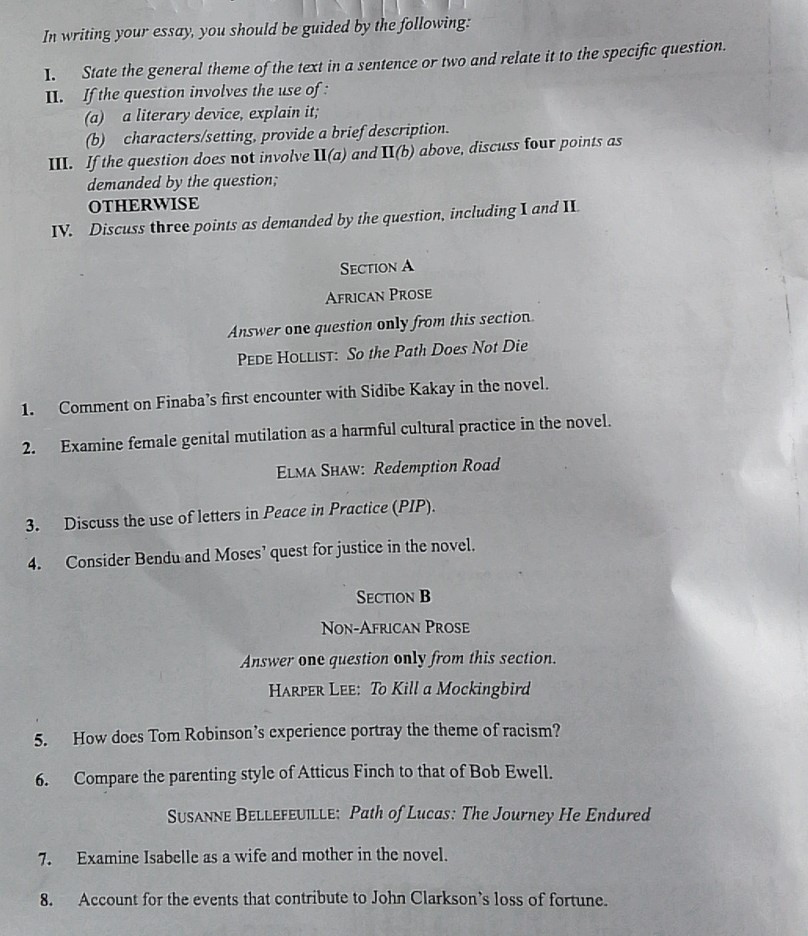
Literature-In-English 2 (Prose) 2:00pm – 3:15pm
Literature-In-English 1 (Objective) 3:15pm – 4:15pm
PLEASE TAKE NOTE: LITERATURE OBJ ANSWERS TICKED ON QUESTION
WAEC MAY RESHUFFLE THE OPTIONS/QUESTIONS
THATS WHY WE ALWAYS TICKED ANSWERS ON QUESTIONS PAPER
CROSS CHECK WITH YOUR OWN QUESTION BEFORE YOU SHADE
LITERATURE OBJ:
1-10: DCDCADBBDB
11-20: BBDBDDBBDD
21-30: DACCBCCBCA
31-40: BBDDCBDBBD
41-50: CABAABBADD






NUMBER 1
(VERSION I)
(1)
Pede Hollist’s So the Path Does Not Die explores themes such as harmful traditional practices, women’s rights, cultural conflict, and social change. One of the major issues addressed in the novel is the suffering caused by certain customs, especially female genital mutilation (FGM). Finaba, a young journalist, becomes involved in the campaign against this practice. Her first encounter with Sidibe Kakay is significant because it introduces an influential character who helps shape her mission and understanding of the problem.
Finaba is the central female character in the novel. She is educated, courageous, and determined to expose social injustices. Sidibe Kakay, on the other hand, is a respected traditional leader and a strong advocate of cultural values. Their first meeting takes place within the context of Finaba’s investigation into the practice of female genital mutilation. This encounter is important because it establishes the relationship between modern reformist ideas and traditional beliefs that runs throughout the novel.
To begin with, Finaba approaches Sidibe Kakay out of professional curiosity and a desire to gather information about the practice of female circumcision. As a journalist, she is interested in understanding why the custom continues despite its harmful effects on women and girls. Her visit demonstrates her commitment to uncovering the truth rather than relying on rumours or assumptions.
More importantly, the meeting reveals Sidibe Kakay’s strong attachment to tradition. During their discussion, he defends the practice of female genital mutilation and presents it as an important cultural rite. He believes that the custom preserves morality, prepares girls for womanhood, and maintains the identity of the community. His views represent those of many traditionalists who resist social change.
In contrast, Finaba’s attitude during the encounter reflects her progressive outlook. Although she respects the elderly leader, she is not intimidated by his status. She listens carefully to his explanations but remains concerned about the pain, health complications, and psychological trauma associated with the practice. Her questioning nature shows her determination to challenge customs that violate human rights.
Furthermore, the encounter highlights the conflict between tradition and modernity. Sidibe Kakay symbolizes the older generation that seeks to preserve long-established customs, while Finaba represents the younger generation advocating reform and social development. Their discussion brings into focus the central tension in the novel, where cultural practices are examined in the light of modern knowledge and human rights principles.
Equally significant is the fact that the meeting broadens Finaba’s understanding of the complexity of the issue. She realizes that the persistence of female genital mutilation is not merely due to ignorance but is deeply rooted in cultural beliefs and social expectations. This realization helps her appreciate the challenges involved in changing attitudes and influencing public opinion.
Another noteworthy aspect of the encounter is the mutual respect displayed by both characters despite their differences. Sidibe Kakay does not dismiss Finaba simply because she is young or because her views differ from his. Likewise, Finaba conducts herself respectfully and professionally. This respectful exchange suggests that meaningful dialogue is necessary for social progress and reform.
Finaba’s first encounter with Sidibe Kakay serves as a turning point in her campaign against female genital mutilation. The discussion strengthens her resolve to educate the public and advocate for the protection of women and girls. It also prepares the reader for the broader debate over culture, tradition, and human rights that unfolds throughout the novel.
Finaba’s first meeting with Sidibe Kakay is a memorable and significant event in So the Path Does Not Die. It introduces the ideological conflict between tradition and change, reveals the characters’ contrasting beliefs, deepens Finaba’s understanding of the issue of FGM, and reinforces her commitment to social reform. Through this encounter, Hollist effectively highlights the challenges involved in confronting harmful cultural practices while promoting positive change in society.
========================
(VERSION II)
(1)
So the Path Does Not Die by Pede Hollist deals with themes of cultural traditions, women’s rights, social justice, and the struggle for change in society. The novel particularly condemns harmful practices that endanger the lives and well-being of women. Finaba’s first encounter with Sidibe Kakay is an important episode because it exposes the clash between traditional beliefs and modern ideas, while also shaping Finaba’s determination to fight against female genital mutilation.
Finaba is a young and educated journalist who is passionate about exposing social problems and defending vulnerable members of society. Sidibe Kakay is an influential elder who commands respect within his community and strongly believes in preserving traditional customs. Their first meeting is significant because it brings together two individuals with opposing views on a sensitive cultural issue.
At the outset, Finaba seeks out Sidibe Kakay in the course of her investigations into female genital mutilation. She wants to hear directly from people who support the practice so that she can gain a balanced understanding of the issue. This demonstrates her professionalism as a journalist who values facts and firsthand information rather than relying solely on public opinion.
In the course of their conversation, Sidibe Kakay presents himself as a staunch defender of tradition. He argues that female circumcision is an age-old practice that should not be abandoned simply because outsiders criticize it. To him, the custom is deeply connected to the values and identity of the community. His position reveals the mindset of many people who see cultural preservation as more important than reform.
Meanwhile, Finaba carefully examines the arguments put forward by Sidibe Kakay. Although she remains respectful throughout the discussion, she is troubled by the suffering endured by victims of the practice. Her concern for the health and dignity of women makes her question whether cultural traditions should continue when they cause physical and emotional harm. This aspect of the encounter emphasizes her courage and independent thinking.
Another important feature of the meeting is the way it reveals the broader conflict that drives the novel. Sidibe Kakay represents conservative forces that resist change, whereas Finaba stands for progress and enlightenment. Through their exchange, the author illustrates how difficult it can be to challenge customs that have been accepted for generations, even when evidence shows that such customs are harmful.
Besides exposing this conflict, the encounter serves as an educational experience for Finaba. She comes to understand that the practice survives not only because people are unaware of its dangers but also because many community members genuinely believe it is necessary. This realization helps her appreciate the depth of the problem and the amount of effort required to change public attitudes.
Equally noteworthy is the atmosphere of civility that characterizes their interaction. Despite their differing opinions, neither character resorts to hostility. Finaba listens attentively, while Sidibe Kakay explains his views openly. Their conduct suggests that social change can be achieved more effectively through dialogue and understanding than through confrontation alone.
The meeting also strengthens Finaba’s resolve to continue her campaign against female genital mutilation. Rather than discouraging her, the arguments she hears convince her that more awareness and education are needed. She becomes even more determined to speak out against practices that threaten the rights and welfare of women and girls.
Finaba’s first encounter with Sidibe Kakay is a crucial event in So the Path Does Not Die. It introduces the ideological battle between tradition and reform, highlights the personalities of both characters, deepens Finaba’s understanding of the issue of female genital mutilation, and inspires her to intensify her efforts toward social change. Through this memorable encounter, Hollist underscores the need to question harmful customs while respecting the importance of constructive dialogue in society.
NUMBER 2
(VERSION I)
(2)
Female genital mutilation (FGM) is one of the major social issues explored in Pede Hollist’s So the Path Does Not Die. The novel generally examines the conflict between harmful traditional practices and modern ideas of human rights, education, and personal freedom. Through the experiences of several characters, Hollist presents female genital mutilation as a dangerous cultural practice that causes physical, emotional, and psychological suffering to women and girls.
The novel is set mainly in Sierra Leone, where some traditional customs continue to influence people’s lives. Female genital mutilation is carried out as part of initiation into the Bondo society, a secret women’s organization that is highly respected in the community. Although many people regard the practice as a symbol of womanhood and cultural identity, the author exposes its harmful effects and challenges its continued existence.
More significantly, the practice causes severe physical pain and health complications for girls who undergo it. During the initiation ceremony, young girls are subjected to the cutting of their genital organs without proper medical care. The procedure is extremely painful and often results in excessive bleeding, infections, and long-term health problems. Through the experiences of victims in the novel, the author demonstrates that FGM is a violation of the bodily integrity of women and girls.
In addition, female genital mutilation deprives girls of the freedom to make decisions about their own bodies. Many of the girls are forced into the practice by parents and community leaders without their consent. They are expected to submit to the tradition regardless of their personal wishes. The novel therefore presents FGM as an act of oppression that denies females the right to choose what happens to them.
Furthermore, the practice causes emotional and psychological trauma. Victims often live with fear, anxiety, and painful memories of the experience. The trauma does not end with the initiation ceremony, as many women continue to suffer emotionally throughout their lives. By portraying these psychological effects, Hollist emphasizes that the damage caused by female genital mutilation extends far beyond the physical injuries.
Equally important, the novel shows how FGM hinders social progress and the advancement of women. Characters who oppose the practice argue that it prevents society from embracing modern values that promote gender equality and human rights. Educated individuals and activists in the novel campaign against the practice because they recognize its harmful consequences. Their efforts highlight the growing awareness that certain traditions should be abandoned when they endanger human well-being.
Another way the author condemns female genital mutilation is through the suffering experienced by families and communities as a result of the practice. Conflicts arise between those who wish to preserve tradition and those who seek reform. These disagreements create tension within families and society. The novel suggests that blind adherence to harmful customs can divide communities and obstruct development.
Finally, Hollist presents education and awareness as effective tools for combating female genital mutilation. Through exposure to modern education and human rights campaigns, many characters begin to question the practice. The novel advocates change by encouraging society to protect the rights, health, and dignity of women and girls rather than subjecting them to harmful cultural rituals.
Female genital mutilation is portrayed in So the Path Does Not Die as a harmful cultural practice that causes physical pain, emotional trauma, health complications, and the denial of personal freedom. Through the depiction of the Bondo society and the experiences of affected characters, Pede Hollist strongly criticizes the practice and calls for its eradication. The novel ultimately promotes human rights, education, and the protection of women as essential steps toward a more progressive society.
======================
(VERSION II)
(2)
Female genital mutilation is one of the central issues discussed in Pede Hollist’s So the Path Does Not Die. The novel explores the clash between tradition and modernity in Sierra Leonean society. Through the experiences of various characters, the author exposes female genital mutilation (FGM) as a harmful cultural practice that threatens the health, rights, and dignity of women and girls.
The novel is set in Sierra Leone, where the Bondo Society plays an important role in the lives of many women. Membership of this society often requires girls to undergo female genital mutilation as part of an initiation rite into womanhood. While supporters of the practice consider it an important cultural tradition, the novel presents it as a dangerous custom that should be discouraged.
To begin with, female genital mutilation endangers the lives of young girls. The operation is usually carried out under unhygienic conditions and without proper medical supervision. As a result, victims may suffer excessive bleeding, infections, and other serious health complications. Through the suffering of affected girls, the author reveals the physical dangers associated with the practice.
Another harmful effect of female genital mutilation is the intense pain inflicted on its victims. The girls are subjected to a painful procedure that leaves lasting scars on their bodies. Instead of being a joyful passage into adulthood, the initiation becomes a traumatic experience. Hollist uses this reality to demonstrate the cruelty hidden behind the cultural justification of the practice.
Likewise, the novel portrays FGM as a violation of the rights of women and girls. Most victims are not given the opportunity to decide whether or not they want to undergo the procedure. Decisions are made by parents, relatives, and community leaders on their behalf. The practice therefore deprives girls of personal choice and control over their own bodies.
The psychological consequences of female genital mutilation are also highlighted in the novel. Many victims experience fear, anxiety, and emotional distress before and after the operation. The painful memories remain with them for years and may affect their confidence and self-esteem. By presenting these emotional effects, the author emphasizes that the harm caused by FGM is not limited to physical injuries alone.
Moreover, the practice contributes to the oppression of women in society. Female genital mutilation is often used as a means of controlling female sexuality and ensuring conformity to traditional expectations. Women who question the practice may face criticism or rejection from members of their community. The novel therefore shows how FGM reinforces gender inequality and limits women’s freedom.
In the same vein, the author presents education as a powerful weapon against the continuation of the practice. Educated individuals and social activists in the novel challenge the belief that FGM is necessary for womanhood. Through awareness campaigns and public discussions, they encourage people to abandon customs that endanger human life. Their efforts reflect the novel’s message that cultural practices should be examined critically rather than accepted blindly.
Ultimately, female genital mutilation creates conflict between defenders of tradition and advocates of change. This tension illustrates the broader struggle between preserving cultural identity and protecting fundamental human rights. The novel suggests that traditions should only be maintained when they promote the welfare of members of society.
In conclusion, Pede Hollist presents female genital mutilation as a harmful cultural practice that causes severe pain, health complications, emotional trauma, and the denial of personal freedom. Through the depiction of the Bondo Society and the experiences of victims, the author condemns the practice and advocates its abolition. The novel concludes that the protection of women’s rights and well-being is more important than the preservation of harmful traditions.
NUMBER 3
(VERSION I)
(3)
Elma Shaw’s Redemption Road is a novel that explores the themes of justice, reconciliation, healing and post-war reconstruction in Liberia after the civil war. Through the activities of Peace in Practice (PIP), the author demonstrates how dialogue, understanding and community participation can promote peace and social recovery. One important literary device employed in the novel is the use of letters, which serve as a means of communication, revelation and conflict resolution.
To begin with, letters serve as a channel of communication between individuals and organizations in the novel. Peace in Practice (PIP), the non-governmental organization committed to peacebuilding, frequently uses letters to contact government agencies, community leaders and other stakeholders. These letters facilitate cooperation and help the organization carry out its peace and reconciliation programmes effectively. Through this device, the author highlights the importance of formal communication in achieving social change.
Furthermore, letters help to reveal important information that advances the plot. Certain details about characters, their experiences and their intentions are communicated through written correspondence. These letters provide insights that may not have been easily obtained through direct conversation. By exposing hidden facts and personal thoughts, the letters contribute significantly to the development of events in the novel.
In addition, letters function as instruments for seeking justice and redress. Many victims of the civil war have suffered loss, displacement and abuse. Through written petitions and formal complaints, individuals are able to present their grievances to relevant authorities. Such letters draw attention to cases of injustice and encourage action toward resolving them. This use of letters reinforces one of the novel’s major concerns—the pursuit of justice in a society recovering from conflict.
Another significant use of letters in PIP is their role in promoting reconciliation. The organization encourages communication among people who were previously divided by war, suspicion and hatred. Written messages provide opportunities for apologies, explanations and expressions of goodwill. Through these exchanges, damaged relationships begin to heal, and communities gradually move toward peaceful coexistence. The letters therefore become tools for rebuilding trust and fostering unity.
Equally important, letters contribute to character development. Through the contents of various letters, readers gain a deeper understanding of the personalities, emotions and motivations of different characters. The letters reveal fears, hopes, regrets and aspirations that may not be openly expressed. Consequently, readers are able to appreciate the emotional struggles and personal growth of the characters more fully.
Moreover, letters help to preserve records and provide evidence. In a society emerging from years of conflict, documentation becomes necessary for accountability and future reference. Official correspondence serves as proof of decisions, agreements and requests made by individuals or organizations. This function underscores the importance of written records in maintaining order and ensuring transparency within the peacebuilding process.
The use of letters enhances the realism of the narrative. In real-life institutions and organizations, formal communication is often conducted through letters. By incorporating them into the novel, Elma Shaw presents a believable picture of how peacebuilding agencies operate. The letters add authenticity to the story and make the events more convincing to readers.
Letters play a vital role in Redemption Road, particularly in the activities of Peace in Practice (PIP). They serve as channels of communication, reveal important information, support the quest for justice, promote reconciliation, aid character development, preserve records and enhance realism. Through the effective use of this literary device, Elma Shaw demonstrates the power of communication in fostering peace and rebuilding a society affected by war.
======================
(VERSION II)
(3)
Elma Shaw’s Redemption Road centres on the themes of justice, reconciliation, healing and national reconstruction in post-war Liberia. The novel portrays the efforts of individuals and organizations to rebuild lives and communities devastated by years of civil conflict. One of the literary devices employed by the author is the use of letters in Peace in Practice (PIP), a peacebuilding organization. These letters play important roles in communication, conflict resolution and the advancement of the plot.
Peace in Practice (PIP) is a non-governmental organization dedicated to promoting peace, reconciliation and justice among Liberians affected by the civil war. Through its activities, the organization seeks to heal divisions within society and encourage peaceful coexistence. The use of letters becomes an important tool through which the organization carries out its objectives and connects with different groups within the society.
Notably, letters serve as an effective medium of communication in the novel. Through written correspondence, PIP communicates with government officials, community leaders, victims of war and other stakeholders involved in peacebuilding efforts. The letters help to convey information clearly and formally, ensuring that important messages reach their intended recipients. This facilitates cooperation and enables the organization to coordinate its activities successfully.
More importantly, letters help to reveal crucial information that advances the plot. Through various exchanges of correspondence, readers gain access to facts that would otherwise remain unknown. These letters disclose personal experiences, concerns and intentions of characters, thereby deepening the reader’s understanding of events. By uncovering hidden truths, the letters contribute significantly to the development of the narrative.
Similarly, letters function as instruments for seeking justice. Many victims of the civil war have suffered severe losses and injustices. Through written complaints, petitions and appeals, affected individuals are able to present their grievances to relevant authorities. Such correspondence draws attention to cases that require intervention and encourages efforts toward redress. In this way, the letters reinforce the novel’s emphasis on justice and accountability.
Equally significant, letters promote reconciliation among individuals and communities. The scars of war have left many people divided by bitterness, mistrust and resentment. Through written messages, opportunities are created for dialogue, apologies and mutual understanding. These exchanges help former enemies and estranged individuals to rebuild relationships and move toward peaceful coexistence. The letters therefore become valuable tools in the healing process championed by PIP.
Furthermore, letters contribute to character development. Through their contents, readers gain insight into the emotions, attitudes and personalities of various characters. Feelings of regret, hope, fear and determination are often expressed more openly in written communication. As a result, the audience develops a deeper appreciation of the struggles and transformations experienced by the characters throughout the novel.
In another respect, letters provide documentation and evidence for important decisions and actions. PIP relies on written records to maintain accountability and ensure transparency in its operations. The letters preserve information that can be referenced when necessary, thereby supporting the organization’s efforts to achieve lasting peace and justice. This function reflects the practical importance of documentation in post-war reconstruction.
In conclusion, the use of letters in Peace in Practice (PIP) is a significant literary device in Redemption Road. They facilitate communication, reveal important information, support the pursuit of justice, promote reconciliation, aid character development and preserve essential records. Through this effective use of letters, Elma Shaw highlights the power of communication as a tool for healing divisions and rebuilding a society recovering from the devastating effects of war.
NUMBER 4
(VERSION I)
(4)
Elma Shaw’s Redemption Road explores themes of justice, human rights, corruption, reconciliation, and the effects of war on society. One of the major concerns of the novel is the struggle of ordinary citizens against oppression and injustice. Through the experiences of Bendu and Moses, the author demonstrates the determination of individuals who seek justice despite numerous obstacles placed in their way.
Bendu is a young woman whose life is shaped by the painful experiences of the civil war, while Moses is a committed journalist who believes in truth and accountability. Together, they become symbols of resistance against injustice and abuse of power. Their quest for justice forms an important aspect of the novel and contributes significantly to its central message.
At the heart of Bendu’s quest for justice is her desire to overcome the suffering inflicted on her during the war. Having experienced violence and exploitation, she seeks recognition for the wrongs committed against victims like herself. Rather than remaining silent, Bendu becomes determined to ensure that the truth about such abuses is known. Her courage reflects the struggle of many war victims who seek justice and healing.
Similarly, Moses pursues justice through his profession as a journalist. He believes that the media should expose wrongdoing and hold leaders accountable for their actions. Instead of ignoring social problems, he investigates issues affecting ordinary people and uses his platform to reveal the truth. Through Moses, the author highlights the important role of journalism in promoting justice and defending the rights of citizens.
Furthermore, both characters challenge corruption and the misuse of authority. They recognize that many powerful individuals take advantage of their positions while innocent people continue to suffer. Their determination to confront such injustices demonstrates their commitment to creating a fairer society. Even when faced with opposition, they refuse to abandon their principles.
Another important aspect of their quest is their search for truth. Bendu and Moses understand that genuine justice cannot exist without truth. They therefore seek to uncover facts, expose hidden crimes, and ensure that victims are heard. Their efforts emphasize the importance of honesty and transparency in the process of achieving justice.
In addition, the two characters display remarkable courage in the face of danger. The individuals and institutions they challenge possess considerable influence and power. Despite the risks involved, Bendu and Moses continue their struggle because they believe that silence would only allow injustice to flourish. Their bravery inspires others to stand up for what is right.
Equally significant is their concern for the welfare of others. Their quest for justice is not motivated by personal gain alone. They seek justice for vulnerable people who have suffered abuse, discrimination, and neglect. Through their actions, they become voices for those who are unable to defend themselves. This selfless commitment makes their struggle meaningful and admirable.
Moreover, their efforts contribute to the broader process of national healing and reconciliation. By exposing wrongdoing and demanding accountability, they help society confront painful truths about its past. The novel suggests that lasting peace can only be achieved when justice is pursued and victims are acknowledged.
Bendu and Moses’ quest for justice is a major element in Redemption Road. Through their search for truth, opposition to corruption, courage in confronting powerful individuals, and commitment to defending victims, they embody the struggle for a more just society. Elma Shaw uses their experiences to emphasize that justice, accountability, and truth are essential for peace and national development.
=======================
(VERSION II)
(4)
Elma Shaw’s Redemption Road examines the consequences of war and the challenges involved in rebuilding a society damaged by violence and corruption. The novel highlights themes such as justice, accountability, truth, and reconciliation. Through the characters of Bendu and Moses, Shaw presents the struggle of individuals who are determined to fight against injustice and ensure that victims receive fair treatment.
Bendu is one of the victims of the civil war whose life has been deeply affected by violence and suffering. Moses, on the other hand, is a journalist committed to exposing the truth and defending the oppressed. Their efforts to seek justice make them important figures in the novel and help to advance its message about the need for accountability in society.
One aspect of Bendu’s quest for justice is her determination to overcome the painful experiences of her past. Having suffered greatly during the war, she refuses to allow her story to be forgotten. She seeks recognition for the suffering of war victims and desires a society where such abuses are not ignored. Through her determination, the novel stresses the importance of giving victims a voice.
In a similar vein, Moses pursues justice by uncovering facts and exposing wrongdoing. As a journalist, he believes that the truth should be made known regardless of the consequences. He investigates issues affecting ordinary citizens and brings hidden problems to public attention. His commitment to honest reporting demonstrates the role of the media in promoting justice and social change.
Another important feature of their quest is their opposition to corruption. Both characters recognize that many social problems persist because some individuals abuse power for personal gain. They challenge such practices and advocate fairness in the treatment of citizens. Their actions reveal the author’s criticism of corruption and her call for responsible leadership.
Moreover, Bendu and Moses seek justice through the exposure of truth. They understand that a society cannot move forward if crimes and abuses remain concealed. By encouraging openness and accountability, they contribute to efforts aimed at addressing past wrongs. Their actions suggest that truth is an essential foundation for justice.
Their courage also plays a significant role in their quest. The pursuit of justice often places them in difficult and dangerous situations. Nevertheless, they remain steadfast in their convictions and refuse to be intimidated. Their bravery reflects the determination required to confront powerful individuals and institutions that stand in the way of justice.
Equally noteworthy is their concern for the less privileged members of society. They do not fight solely for themselves but also for people who lack the power to defend their rights. Through their advocacy, they become representatives of the weak and oppressed. This concern for others gives moral strength to their struggle and reinforces the novel’s humanitarian message.
Finally, their efforts contribute to national healing and reconciliation. By demanding accountability and encouraging the acknowledgment of past wrongs, they help create conditions for lasting peace. The novel suggests that genuine reconciliation can only occur when justice is pursued and victims are treated with dignity.
In conclusion, Bendu and Moses’ quest for justice is a central aspect of Redemption Road. Through their search for truth, resistance to corruption, courage in the face of opposition, and commitment to helping victims, they symbolize the struggle for fairness and accountability. Elma Shaw uses their experiences to show that justice is essential for healing, reconciliation, and the creation of a better society.
NUMBER 5
(VERSION I)
(5)
Tom Robinson’s experience in Harper Lee’s To Kill a Mockingbird vividly portrays the theme of racism in the American South. The novel generally examines prejudice, injustice, and the loss of innocence in a society divided along racial lines. Through Tom Robinson’s arrest, trial, conviction, and eventual death, Harper Lee exposes the deep-rooted racial discrimination that denies Black people justice and equality.
Tom Robinson is a hardworking and compassionate Black man living in Maycomb, Alabama. Despite his good character, he becomes a victim of racial prejudice when he is falsely accused of raping Mayella Ewell, a white woman. His experiences throughout the novel reveal how racism influences the attitudes and actions of individuals and institutions in society.
At the outset, Tom becomes a victim of a false accusation simply because of his race. Mayella Ewell makes advances toward Tom, but when her father, Bob Ewell, discovers her actions, she accuses Tom of rape to conceal the truth. Although there is no credible evidence against him, Tom is arrested because the word of a white person is automatically valued above that of a Black person. This situation demonstrates the racial bias that exists in Maycomb.
Furthermore, Tom is denied equal treatment under the law. During the trial, Atticus Finch presents convincing evidence proving that Tom could not have committed the crime. He shows that Tom’s left arm is crippled, making it impossible for him to have inflicted the injuries found on Mayella. Atticus also exposes contradictions in the testimonies of Mayella and Bob Ewell. Despite these facts, the jury refuses to acquit Tom because he is Black. The verdict illustrates how racism can override truth and justice.
Equally significant is the prejudice shown by members of the white community. Long before the trial begins, many people assume that Tom is guilty solely because of the colour of his skin. The townspeople are unwilling to consider the possibility that a white accuser might be lying. Their attitude reflects a society where racial stereotypes are deeply entrenched.
Moreover, Tom’s respectful behaviour during the trial is twisted against him because of racial prejudice. When Tom explains that he felt sorry for Mayella because of her lonely and difficult life, many white spectators react negatively. In the racist social order of Maycomb, a Black man expressing pity for a white woman is considered unacceptable. This reaction further highlights the extent of racial discrimination in the society.
Another indication of racism is seen in Tom’s lack of hope after his conviction. Although Atticus plans to appeal the judgment, Tom realizes that the legal system is unlikely to treat him fairly because of his race. Feeling trapped and hopeless, he attempts to escape from prison. His decision reflects his awareness that justice is almost impossible for a Black man in a racist society.
Most tragically, Tom loses his life while trying to escape custody. He is shot multiple times by prison guards. His death symbolizes the destruction of innocent Black lives by a system built on racial inequality. Even after his death, many white citizens show little sympathy, further revealing the dehumanizing effects of racism.
Tom Robinson’s experience is a powerful portrayal of the theme of racism in To Kill a Mockingbird. Through his false accusation, unfair trial, wrongful conviction, hopelessness, and death, Harper Lee demonstrates how racial prejudice corrupts justice and destroys innocent lives. Tom’s tragic story serves as a strong condemnation of racism and a call for equality, fairness, and human dignity.
========================
(VERSION II)
(5)
Tom Robinson’s experience in Harper Lee’s To Kill a Mockingbird is a clear portrayal of the theme of racism. The novel explores prejudice, injustice, and the unequal treatment of Black people in the American South. Through Tom Robinson’s suffering, Harper Lee exposes a society where racial discrimination is so deeply rooted that an innocent Black man can be denied justice simply because of the colour of his skin.
Tom Robinson is a kind and hardworking Black man who becomes the victim of a false accusation. He is accused of raping Mayella Ewell, a poor white woman. Although he is innocent, his race immediately places him at a disadvantage. The events surrounding his arrest, trial, conviction, and death reveal the extent of racism in Maycomb and help to develop the novel’s central message about social injustice.
To begin with, Tom is wrongly accused because he is Black. The evidence suggests that Mayella initiated contact with Tom and later accused him of rape to hide her actions from her father. Instead of investigating the facts fairly, the authorities quickly arrest Tom. The accusation itself demonstrates the racial prejudice of the society, where the word of a white person is automatically believed over that of a Black person.
In addition, Tom faces discrimination throughout his trial. Atticus Finch, his lawyer, presents strong evidence that proves Tom’s innocence. He shows that Tom’s left arm is crippled and therefore could not have caused Mayella’s injuries. Atticus also exposes several inconsistencies in the testimonies of Mayella and Bob Ewell. Despite these facts, the jury chooses to convict Tom. This verdict reveals that racial bias is more powerful than truth and justice in Maycomb.
Furthermore, the attitudes of many townspeople reflect the widespread nature of racism. Before the trial even begins, numerous white residents assume that Tom is guilty. They are unwilling to believe that a white woman could lie or that a Black man could be innocent. Their judgment is based not on evidence but on racial prejudice. Through these reactions, Harper Lee shows how racism shapes public opinion.
Another aspect of racism is seen in the way Tom’s kindness is misunderstood. During the trial, he admits that he often helped Mayella with chores because he felt sorry for her difficult situation. However, many people are offended by this statement. In the racist society of Maycomb, it is considered inappropriate for a Black man to pity a white woman. This response highlights the social barriers created by racial discrimination.
Most importantly, racism ultimately leads to Tom’s destruction. After being convicted, he loses hope in the legal system and attempts to escape from prison. He is shot and killed during the attempt. His tragic death symbolizes the fate of many innocent Black people whose lives are ruined by prejudice and injustice.
In conclusion, Tom Robinson’s experience strongly portrays the theme of racism in To Kill a Mockingbird. His false accusation, unfair trial, wrongful conviction, and tragic death demonstrate how deeply racial prejudice affects society. Through Tom’s story, Harper Lee condemns racism and emphasizes the need for justice, equality, and respect for all human beings regardless of race.
NUMBER 6
(VERSION I)
(6)
Harper Lee’s To Kill a Mockingbird explores themes such as justice, morality, prejudice, courage, and family values. Through the characters of Atticus Finch and Bob Ewell, the novel presents two contrasting approaches to parenting. While Atticus raises his children with love, discipline, and moral guidance, Bob Ewell is portrayed as a neglectful and irresponsible father whose poor example negatively affects his children. The comparison between the two men highlights the importance of good parenting in shaping a child’s character.
Atticus Finch is a respected lawyer and a widower who lives in Maycomb with his children, Jem and Scout. He is known for his wisdom, fairness, and integrity. Bob Ewell, on the other hand, belongs to one of the poorest families in Maycomb and is notorious for his drunkenness, laziness, and immoral behaviour. The contrast between these two fathers is evident throughout the novel.
To begin with, Atticus is a loving and caring father, whereas Bob Ewell is neglectful and abusive. Atticus takes a personal interest in the lives of Jem and Scout and ensures that they feel loved and protected. He spends time with them, listens to their concerns, and offers guidance whenever necessary. In contrast, Bob Ewell shows little affection toward his children. He neglects their welfare and fails to provide them with the care and protection they deserve.
Furthermore, Atticus teaches his children important moral values. He encourages Jem and Scout to be honest, respectful, tolerant, and compassionate. One of his most memorable lessons is that a person should try to understand others by seeing things from their point of view. Through these teachings, he helps his children develop strong moral principles. Bob Ewell, however, provides no such guidance. Instead, he serves as a negative example through his dishonesty, prejudice, and irresponsible lifestyle.
Equally important is Atticus’s commitment to education and personal development. He encourages Scout and Jem to read, learn, and think independently. He answers their questions patiently and helps them understand the complexities of the world around them. Bob Ewell demonstrates little concern for the education of his children. His neglect contributes to the poor conditions in which they are raised and limits their opportunities for growth.
Moreover, Atticus leads by example. He demonstrates courage by defending Tom Robinson despite criticism from many members of the community. His actions teach his children the importance of standing up for what is right even when it is unpopular. Bob Ewell, by contrast, displays cowardice and vindictiveness. After the trial, he seeks revenge against those he blames for his humiliation. His behaviour teaches negative values rather than positive ones.
Another striking difference is the atmosphere each father creates within his family. Atticus maintains a peaceful and stable home where his children feel secure and respected. Communication and mutual understanding characterize his relationship with Jem and Scout. In contrast, the Ewell household is marked by disorder, fear, and neglect. Bob Ewell’s actions create an unhealthy environment for his children, particularly Mayella, who suffers greatly because of his behaviour.
Finally, the results of their parenting styles are clearly reflected in their children. Jem and Scout grow into thoughtful, responsible, and compassionate individuals because of Atticus’s influence. Mayella Ewell, however, grows up in an environment of poverty, loneliness, and emotional neglect, which contributes to the tragic choices she makes.
In conclusion, Atticus Finch and Bob Ewell represent two opposing parenting styles in To Kill a Mockingbird. Atticus is loving, responsible, morally upright, and supportive, while Bob Ewell is neglectful, abusive, and irresponsible. Through this contrast, Harper Lee emphasizes the significant role parents play in shaping the character and future of their children.
=========================
(VERSION II)
(6)
Harper Lee’s To Kill a Mockingbird explores important themes such as justice, morality, prejudice, courage, and the influence of family. The novel demonstrates how parents shape the lives and values of their children. Through Atticus Finch and Bob Ewell, Harper Lee presents two completely different parenting styles. While Atticus is a responsible and caring father who nurtures his children with wisdom and love, Bob Ewell is a negligent and abusive parent whose actions negatively affect his children.
Atticus Finch is a respected lawyer and the father of Jem and Scout Finch. He is admired in Maycomb for his honesty, intelligence, and strong moral principles. Bob Ewell, on the other hand, is a poor, unemployed man who is known for his drunkenness and irresponsible behaviour. Their attitudes toward parenting reveal a sharp contrast between positive and negative parental influence.
One major difference between the two fathers is the level of care they show toward their children. Atticus genuinely loves Jem and Scout and makes their well-being a priority. He takes time to understand their feelings and guide them through life’s challenges. In contrast, Bob Ewell pays little attention to the welfare of his children. He neglects their needs and fails to provide them with the support and affection that children require.
Similarly, Atticus raises his children through reason and communication, whereas Bob Ewell relies on fear and intimidation. Whenever Jem and Scout make mistakes, Atticus calmly explains what they have done wrong and helps them learn from their experiences. His approach encourages understanding and personal growth. Bob Ewell, however, creates an atmosphere of fear in his home. His aggressive behaviour prevents healthy communication between him and his children.
Another notable difference lies in the values they teach. Atticus constantly encourages his children to be fair, honest, and respectful toward others. He teaches them not to judge people based on race, social status, or appearance. His famous lessons about empathy help Jem and Scout become compassionate individuals. Bob Ewell, however, sets a poor example through his dishonesty and prejudice. Instead of teaching positive values, he exposes his children to immoral behaviour.
Moreover, Atticus encourages education and intellectual development. He supports Scout’s curiosity and helps both children develop a love for learning. He believes that education is important for personal growth and responsible citizenship. Bob Ewell shows little concern for education. His children grow up in conditions that do not encourage learning or self-improvement, reflecting his lack of parental responsibility.
In addition, Atticus serves as a role model through his actions. By defending Tom Robinson despite public criticism, he demonstrates courage, integrity, and a commitment to justice. Jem and Scout learn valuable life lessons from observing his conduct. Bob Ewell presents the opposite example. His lies during the trial and his desire for revenge after the verdict reveal his lack of moral character.
The effects of these parenting styles are evident in their children. Jem and Scout grow into respectful, thoughtful, and morally conscious young people because of Atticus’s guidance. Mayella and the other Ewell children, however, suffer from neglect and poor upbringing, which contribute to their difficult circumstances.
In conclusion, Atticus Finch and Bob Ewell represent two contrasting models of parenthood in To Kill a Mockingbird. Atticus is loving, patient, responsible, and morally upright, while Bob Ewell is neglectful, abusive, and dishonest. Through this contrast, Harper Lee emphasizes that good parenting plays a crucial role in shaping a child’s character and future.
NUMBER 7
(VERSION I)
(7)
Susanne Bellefeuille’s Path of Lucas: The Journey He Endured explores themes such as family, love, sacrifice, perseverance, and parental responsibility. Through the character of Isabelle, the author presents the important roles played by women in maintaining family unity and providing emotional support. As a wife and mother, Isabelle demonstrates love, commitment, patience, and selflessness despite the numerous challenges faced by her family.
Isabelle is portrayed as a devoted wife who remains loyal to her husband, John Clarkson, during difficult times. At the beginning of their marriage, she enjoys a comfortable life with her family. However, when John begins to experience financial setbacks and eventually loses much of his fortune, Isabelle does not abandon him. Instead, she stands by him and shares in his struggles. Her loyalty shows that she values her marriage beyond material wealth and comfort.
Furthermore, Isabelle proves herself to be a supportive partner. Throughout the family’s hardships, she offers encouragement to her husband and helps him cope with the emotional burden of financial loss. Rather than adding to his worries, she provides reassurance and stability. Her support contributes significantly to the family’s ability to withstand difficult circumstances.
Equally important, Isabelle is a loving and caring mother. She shows deep affection for her children and is concerned about their welfare. She strives to provide them with the care, guidance, and protection they need despite the challenges facing the family. Her maternal instincts are evident in the sacrifices she makes to ensure that her children are safe and properly raised.
In addition, Isabelle demonstrates remarkable selflessness. As the family’s economic situation deteriorates, she willingly sacrifices many comforts and personal desires for the sake of her husband and children. She places the needs of her family above her own interests and remains committed to their well-being. This quality makes her an admirable mother and wife.
Another notable aspect of Isabelle’s character is her resilience. The family’s financial decline creates uncertainty and hardship, yet she does not give in to despair. Instead, she faces the situation with courage and determination. Her ability to remain strong during difficult times serves as a source of inspiration to other members of the family.
Moreover, Isabelle contributes to the unity of the family. She encourages understanding and cooperation among family members and helps maintain harmony in the home. Her presence provides emotional balance and strengthens the bond between parents and children. Through her actions, the author emphasizes the importance of women in preserving family stability.
The novel also presents Isabelle as a responsible mother who is concerned with the moral development of her children. She seeks to instill good values such as honesty, perseverance, respect, and compassion. Her guidance helps shape the character of her children and prepares them to face life’s challenges responsibly.
Isabelle is portrayed as an exemplary wife and mother in Path of Lucas: The Journey He Endured. Her loyalty to her husband, unwavering support during hardship, love for her children, selflessness, resilience, and commitment to family unity make her a remarkable character. Through Isabelle, Susanne Bellefeuille highlights the vital role of women in nurturing families and overcoming life’s difficulties.
====================
(VERSION II)
(7)
Susanne Bellefeuille’s Path of Lucas: The Journey He Endured examines the challenges faced by families and the importance of love, sacrifice, and perseverance in overcoming difficulties. Through the character of Isabelle, the author presents the ideal qualities of a devoted wife and caring mother. Isabelle plays a significant role in the family by providing emotional support, maintaining unity, and making sacrifices for the welfare of her husband and children.
Isabelle is first portrayed as a loving and faithful wife. Marriage brings both joy and challenges, and she remains committed to her husband throughout these experiences. When financial difficulties begin to affect the family, she does not lose confidence in him or abandon her responsibilities. Instead, she continues to stand by him, proving that her loyalty is based on genuine love rather than material benefits. Her unwavering commitment strengthens the bond between them and helps the family survive difficult times.
Another important aspect of Isabelle’s role as a wife is her supportive nature. She understands the pressures and disappointments faced by her husband and constantly encourages him to remain hopeful. Rather than criticizing him for the family’s problems, she offers comfort and reassurance. Her words and actions help reduce tension within the home and create an atmosphere of understanding. Through this quality, the author shows that a successful marriage depends on mutual support and cooperation.
As a mother, Isabelle demonstrates deep affection for her children. She is genuinely concerned about their happiness, safety, and future. Despite the hardships experienced by the family, she continues to care for them and provide guidance whenever necessary. Her love is evident in the attention she gives to their needs and in her determination to protect them from unnecessary suffering. This maternal devotion makes her a central figure in the family.
Moreover, Isabelle is highly self-sacrificing. She willingly gives up personal comforts and desires in order to ensure the well-being of her children and husband. During periods of financial hardship, she accepts difficult circumstances without complaint and focuses on helping the family adjust to their new reality. Her sacrifices demonstrate her selflessness and her willingness to place the interests of her loved ones above her own.
Equally significant is her resilience in the face of adversity. The family encounters several challenges that could easily discourage an ordinary person. However, Isabelle remains strong and optimistic. She refuses to allow hardship to destroy her family or weaken her sense of responsibility. Her courage inspires other members of the household and helps them remain united during trying times.
Furthermore, Isabelle serves as a source of stability within the home. She promotes peace, understanding, and cooperation among family members. Whenever difficulties arise, she contributes to resolving them and encourages everyone to remain focused on the values that hold the family together. Her efforts help maintain harmony and strengthen family relationships.
In conclusion, Isabelle is portrayed as an exemplary wife and mother in Path of Lucas: The Journey He Endured. Her loyalty, supportiveness, love, self-sacrifice, resilience, and dedication to family unity make her an admirable character. Through Isabelle, Susanne Bellefeuille emphasizes the importance of strong family values and highlights the crucial role played by women in sustaining and nurturing the family.
NUMBER 8
(VERSION I)
(8)
Susanne Bellefeuille’s Path of Lucas: The Journey He Endured explores themes of family, perseverance, sacrifice, and the challenges that life sometimes presents. One of the significant events in the novel is the financial downfall of John Clarkson. Once a wealthy and successful man, John experiences a series of unfortunate events that eventually lead to the loss of his fortune. These experiences not only affect him personally but also have a profound impact on his family.
John Clarkson is portrayed as a hardworking and ambitious man who initially enjoys financial success and a comfortable lifestyle. However, circumstances beyond his control, coupled with some unfortunate decisions, gradually erode his wealth. His loss of fortune serves as a lesson about the unpredictability of life and the importance of resilience in times of hardship.
To begin with, poor business decisions contribute significantly to John Clarkson’s financial decline. In his desire to expand his wealth and maintain his standard of living, he becomes involved in ventures that do not yield the expected returns. Instead of generating profits, these investments result in considerable financial losses. The failure of these ventures weakens his financial position and marks the beginning of his troubles.
Furthermore, economic difficulties play an important role in his downfall. Changes in business conditions and financial instability affect his sources of income. As revenue decreases and expenses continue to rise, John finds it increasingly difficult to sustain his former lifestyle. The unfavourable economic situation worsens his financial challenges and accelerates the loss of his wealth.
Another factor responsible for his loss of fortune is the accumulation of debts. As financial pressures mount, John becomes unable to meet various financial obligations. Loans and other liabilities begin to pile up, creating additional burdens. The growing debt reduces his financial flexibility and makes recovery increasingly difficult.
In addition, unexpected personal and family responsibilities place further strain on his resources. John is committed to providing for his family and ensuring their well-being. However, the expenses associated with caring for loved ones and dealing with unforeseen circumstances consume a significant portion of his remaining wealth. These obligations contribute to the depletion of his financial reserves.
Equally important is the emotional stress that accompanies his financial difficulties. As his fortunes decline, John experiences anxiety and disappointment. The pressure of trying to restore his finances affects his judgment and decision-making. In some instances, this stress leads to choices that further complicate his situation and hinder his recovery.
Moreover, the loss of fortune is compounded by a series of misfortunes that occur at critical moments in his life. These setbacks make it difficult for him to regain financial stability even when opportunities arise. The combination of bad luck and unfavourable circumstances deepens his struggles and prolongs his hardship.
Despite these challenges, John Clarkson does not completely lose hope. He continues to face his difficulties with determination and seeks ways to rebuild his life. His perseverance in the face of adversity highlights one of the novel’s major messages: that true strength is revealed during periods of hardship.
In conclusion, John Clarkson’s loss of fortune results from a combination of poor business decisions, economic difficulties, mounting debts, family responsibilities, emotional stress, and unfortunate circumstances. Through his experiences, Susanne Bellefeuille demonstrates that wealth can be temporary and that resilience is essential when facing life’s challenges. The novel ultimately emphasizes the importance of courage, perseverance, and family support in overcoming adversity.
==========================
(VERSION II)
(8)
Susanne Bellefeuille’s Path of Lucas: The Journey He Endured explores themes of perseverance, family solidarity, sacrifice, and the unpredictable nature of life. One of the major events in the novel is the financial downfall of John Clarkson. Although he once enjoys wealth and a comfortable lifestyle, a series of unfortunate events gradually strip him of his fortune. His experience demonstrates how quickly prosperity can disappear and how important resilience is during difficult times.
John Clarkson is presented as a successful family man who works hard to provide a good life for his wife and children. However, his financial stability does not last forever. Various circumstances combine to undermine his wealth and eventually plunge him into hardship. The events surrounding his loss of fortune form a significant part of the novel.
A major factor responsible for John’s financial decline is his involvement in unsuccessful investments. Hoping to increase his wealth, he commits substantial resources to ventures that fail to produce the expected profits. Instead of strengthening his financial position, these investments result in losses that weaken his economic standing. The collapse of these business efforts marks the beginning of his financial troubles.
Another event that contributes to his downfall is the deterioration of his business affairs. As challenges arise within his professional activities, his income begins to decline. The reduction in earnings makes it increasingly difficult for him to meet his financial commitments. Consequently, the comfortable life he once enjoyed becomes difficult to maintain.
Moreover, mounting financial obligations worsen his situation. As his sources of income decrease, his expenses continue to increase. Bills, debts, and other responsibilities place heavy pressure on his limited resources. The growing burden of these obligations accelerates the depletion of his wealth and leaves him struggling to remain financially stable.
Family responsibilities also play a significant role in his loss of fortune. John remains committed to caring for his wife and children despite his declining financial condition. The cost of meeting the needs of his family consumes much of his remaining resources. Although these responsibilities are necessary, they further reduce his ability to recover financially.
Equally important are the unexpected setbacks that occur in his life. Circumstances beyond his control create additional challenges that make it difficult for him to regain his former status. These misfortunes come at critical moments and worsen an already fragile situation. The accumulation of such setbacks contributes significantly to the loss of his fortune.
Furthermore, the emotional strain resulting from his financial difficulties affects his ability to make sound decisions. As he becomes increasingly worried about his circumstances, he experiences frustration and anxiety. This emotional pressure sometimes influences his judgment and complicates his efforts to rebuild his finances.
Despite losing much of his wealth, John refuses to surrender to despair. He faces his difficulties with determination and continues to search for ways to improve his situation. His perseverance in the face of hardship demonstrates strength of character and reinforces one of the novel’s central messages about endurance.
In conclusion, John Clarkson’s loss of fortune is caused by unsuccessful investments, declining business fortunes, increasing financial obligations, family responsibilities, unexpected setbacks, and emotional stress. Through his experiences, Susanne Bellefeuille shows that wealth is not permanent and that challenges can arise unexpectedly. The novel ultimately teaches that courage, persistence, and family support are essential for overcoming adversity and rebuilding one’s life.
OBJECTIVES ↘️






PROSE ↘️