
Thursday, 11th June 2026
Chemistry 2 (Essay) 9:30am – 11:30am
Chemistry 1 (Objective) 11:30am – 12:30pm
NOTE:
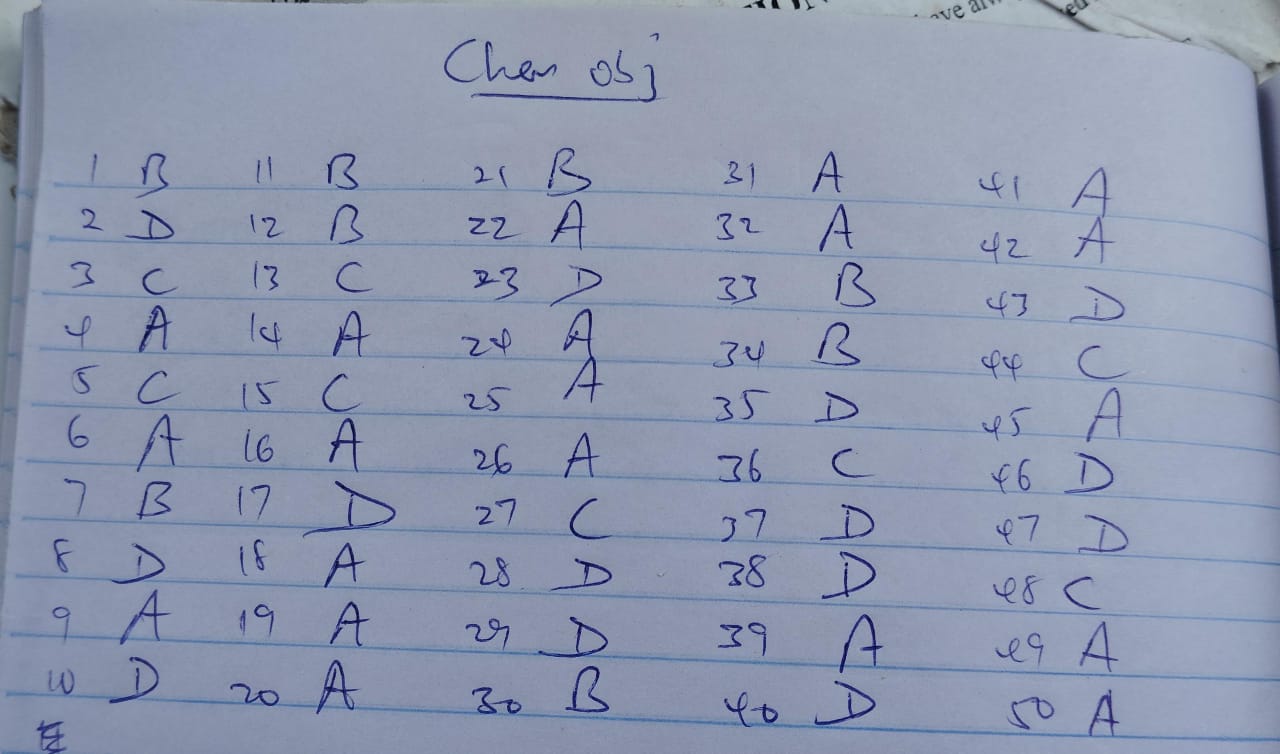
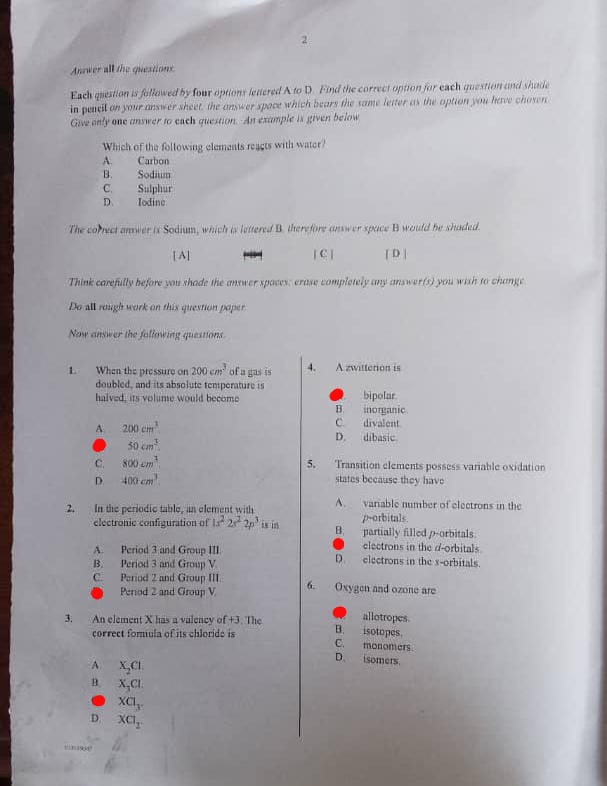
CHEMISTRY OBJ question numbers and answer options are reshuffled for different centers.
This means:
Your Center Question 25 may be another person’s Center Question 30.
Likewise, the answer options may also be rearranged. For example, Option A in your Question 25 could appear as Option B in another person’s Question 30.
CHEMISTRY OBJ:
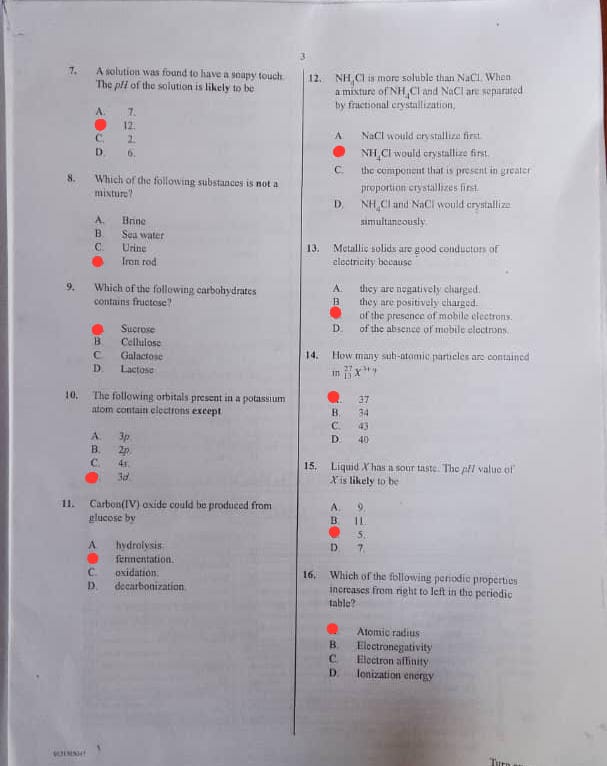
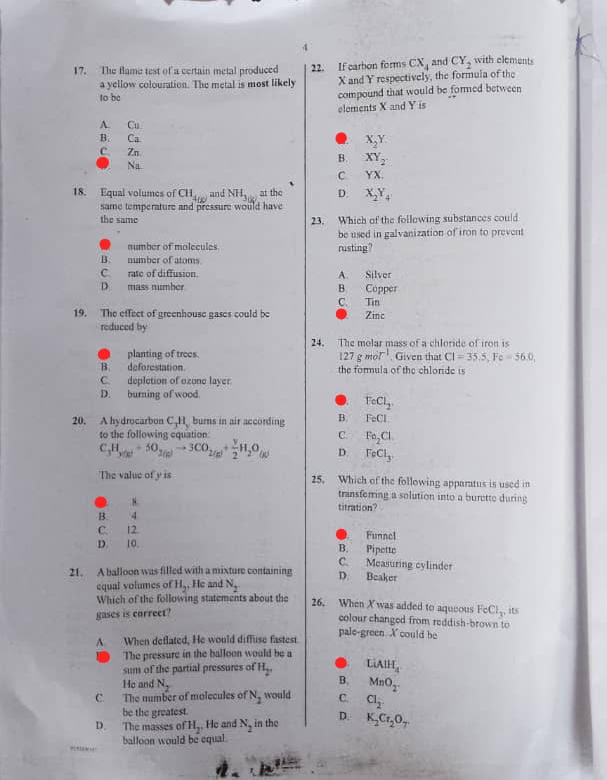
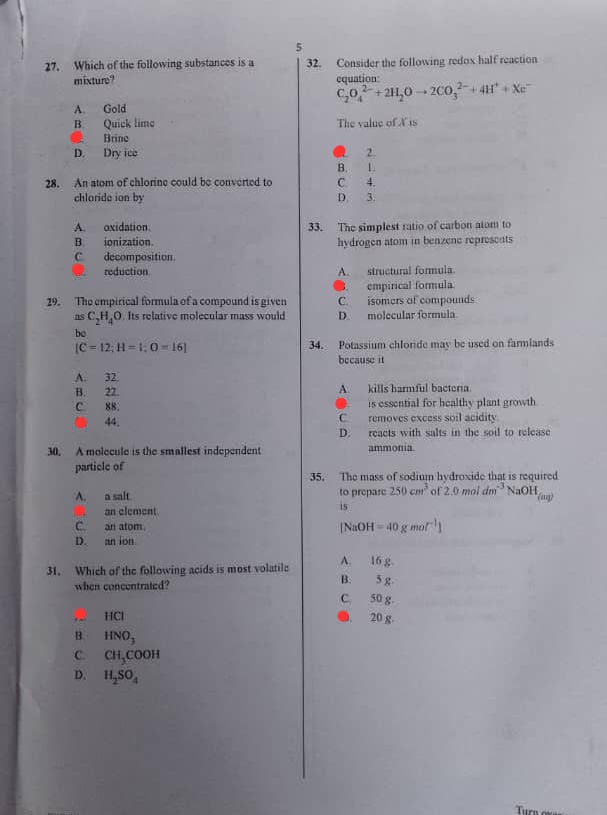
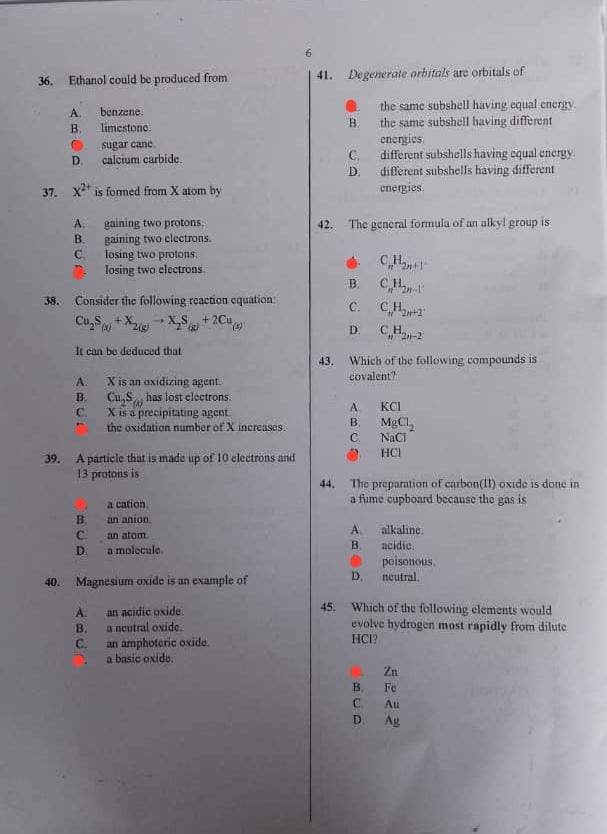
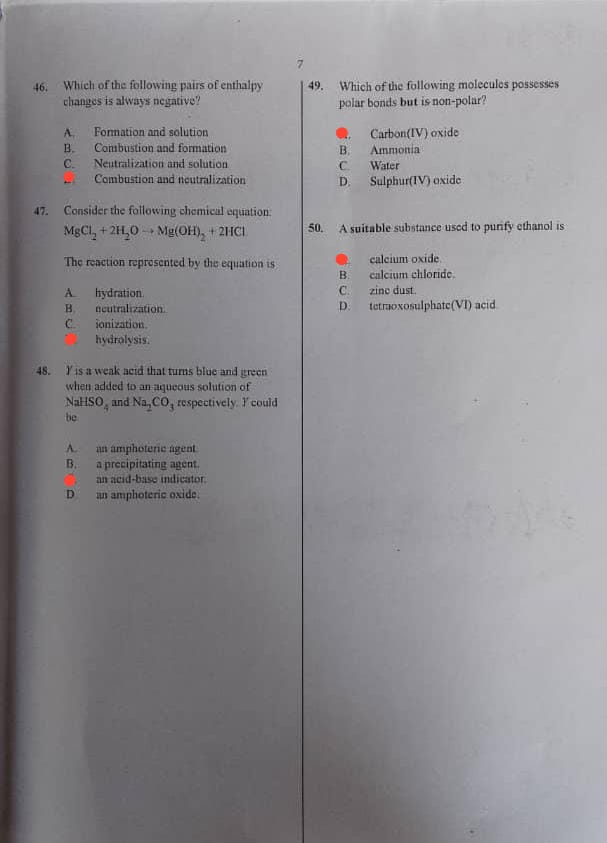
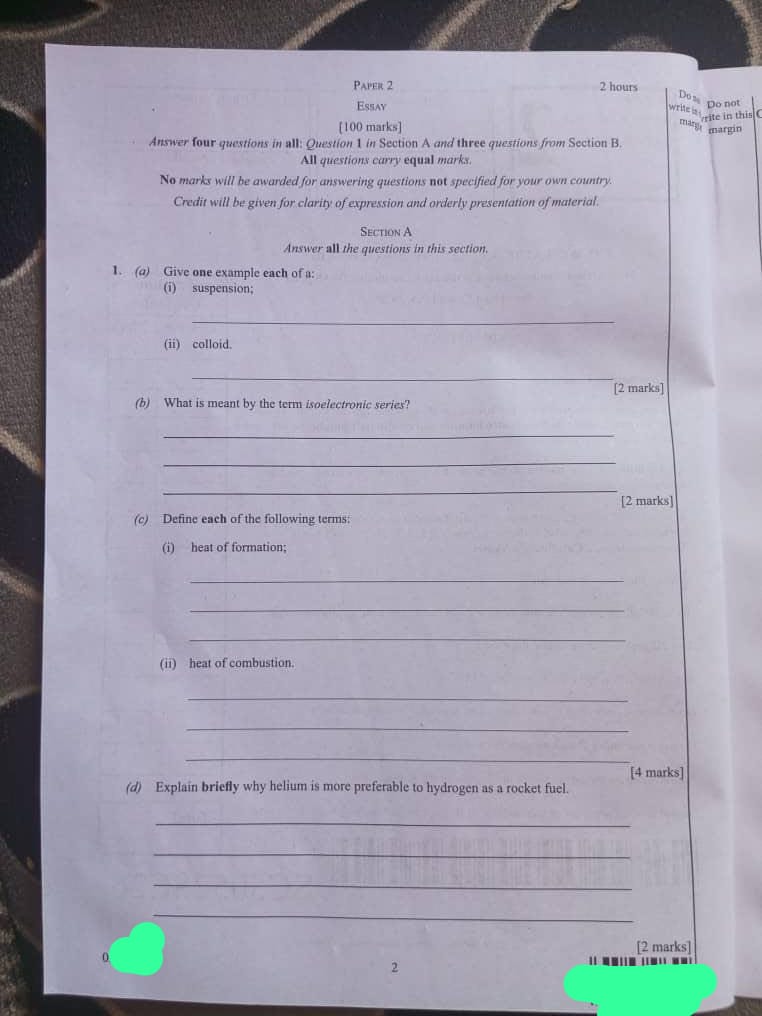
NUMBER 1
(1ai)
Suspension:
(PICK ANY ONE)
-Muddy water
-Sand in water
-Flour in water
(1aii)
Colloid:
(PICK ANY ONE)
-Milk
-Starch solution
-Fog
-Smoke
-Gelatin
(1b)
(PICK ANY ONE)
An isoelectronic series is a group of atoms or ions having the same number of electrons and the same electronic configuration.
OR
An isoelectronic series is a group of atoms, ions, or molecules that contain the same number of electrons but have different nuclear charges (different numbers of protons).
(1ci)
Heat of formation:
The heat change when one mole of a compound is formed from its constituent elements in their standard states under standard conditions.
(1aii)
Heat of combustion:
The heat evolved when one mole of a substance is completely burnt in excess oxygen under standard conditions.
(1d)
(PICK ANY ONE)
Helium is preferred to hydrogen because it is chemically inert and non-flammable. Whereas hydrogen is highly flammable and can form explosive mixtures with air. Therefore, helium is safer to use.
OR
Helium is preferred to hydrogen because it is a noble gas and is chemically inert, so it does not react readily and is non-flammable. Hydrogen, on the other hand, is highly flammable and can form explosive mixtures with air.
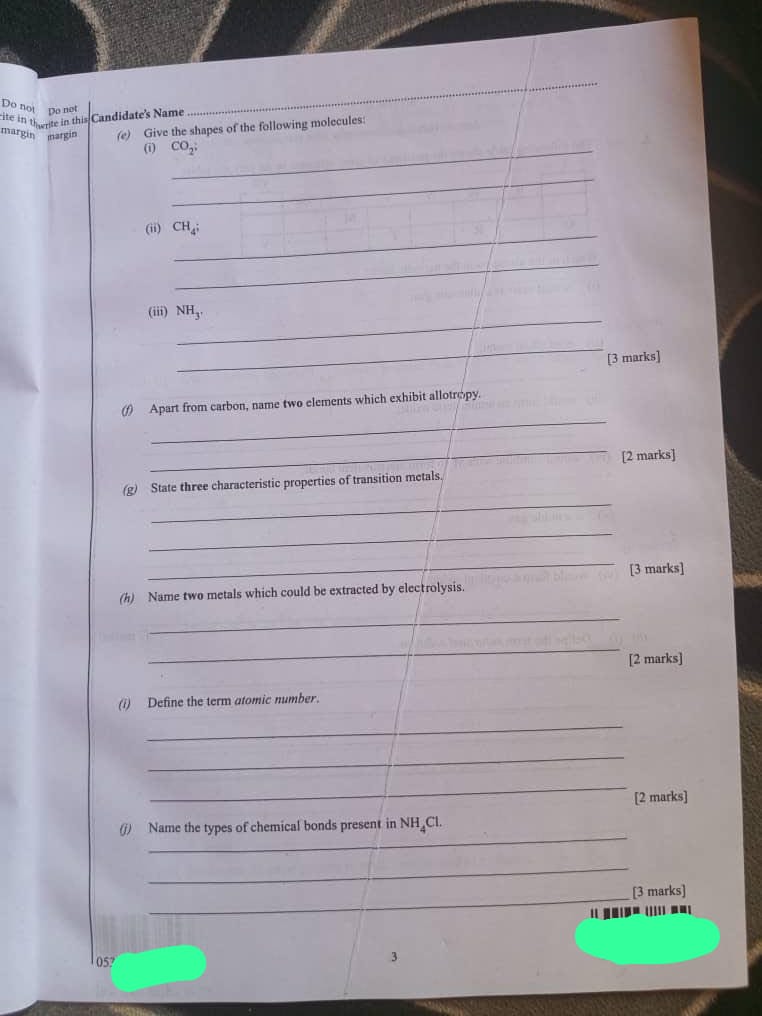
(1e)
(i) CO₂ – Linear
(ii) CH₄ – Tetrahedral
(iii) NH₃ – Trigonal pyramidal
(1f)
(i) Sulphur
(ii) Phosphorus
(1g)
(PICK ANY THREE)
(i) They exhibit variable oxidation states.
(ii) They form coloured ions or compounds.
(iii) They readily form complex ions
(iv) They act as catalysts.
(v) They have high melting and boiling points.
(1h)
(i) Aluminium
(ii) Sodium
(1i)
(PICK ANY ONE)
The atomic number of an element is the number of protons in the nucleus of an atom of that element.
OR
Atomic number is the number of protons contained in the nucleus of an atom of an element.
(1j)
(i) Ionic (electrovalent) bond between NH₄⁺ and Cl⁻.
(ii) Covalent bond between N and H atoms in NH₄⁺.
(iii) Dative (coordinate) bond formed when NH₃ donates a lone pair to H⁺ to form NH₄⁺.
=============================
(VERSION II)
(1ai)
Suspension:
(PICK ANY ONE)
(i) Sand in water
(ii) Chalk powder in water
(iii) Muddy water
(iv) Flour in water
(v) Charcoal powder in water
(1aii)
Colloid:
(PICK ANY ONE)
(i) Milk
(ii) Blood
(iii) Fog
(iv) Starch solution
(v) Gelatin solution
(1b)
(PICK ANY ONE)
Isoelectronic series is a group of atoms, ions or molecules that possess the same number of electrons and hence the same electronic configuration.
OR
Isoelectronic series is a collection of atoms, ions or molecules which have identical electronic structures but may differ in their atomic numbers and nuclear charges.
OR
Isoelectronic series refers to a set of chemical species having the same total number of electrons and similar electron arrangements, although they may possess different chemical properties.
(1ci)
Heat of formation:
(PICK ANY ONE)
Heat of formation is the heat change accompanying the formation of one mole of a compound from its constituent elements in their standard states under standard condition
OR
Heat of formation is the heat change when one mole of a compound is formed from its constituent elements in their standard states.
OR
Heat of formation is the amount of heat evolved or absorbed when one mole of a compound is produced from its constituent elements in their standard states.
(1cii)
Heat of combustion
(PICK ANY ONE)
Heat of combustion is the heat change when one mole of a substance is completely burnt in excess oxygen under standard conditions.
OR
Heat of combustion is the amount of heat evolved when one mole of a substance undergoes complete burning in excess oxygen under standard conditions.
OR
Heat of combustion is the enthalpy change accompanying the complete combustion of one mole of a substance in oxygen.
(1d)
(PICK ANY ONE)
Helium is preferred because it is a noble gas with a completely filled outermost shell. As a result, it is chemically inert and does not readily react with other substances, making it safe for use in airships and weather balloons.
OR
Helium is non-flammable and does not support combustion. Hydrogen, on the other hand, burns readily in air and can form explosive mixtures with oxygen, making helium a much safer lifting gas.
(1e)
(i) Linear shape
(ii) Tetrahedral shape
(iii) Trigonal pyramidal shape
(1f)
(PICK ANY TWO)
(i) Sulphur
(ii) Phosphorus
(iii) Oxygen
(iv) Tin
(1g)
(PICK ANY THREE)
(i) They exhibit variable oxidation states (variable valencies).
(ii) They form coloured ions and compounds.
(iii) They readily form complex ions (coordination compounds).
(iv) They possess catalytic properties and are used as catalysts in many chemical reactions.
(v) They have high melting and boiling points.
(vi) They are good conductors of heat and electricity.
(1h)
(PICK ANY TWO)
(i) Sodium (Na)
(ii) Aluminium (Al)
(iii) Potassium (K)
(iv) Calcium (Ca)
(1i)
(PICK ANY ONE)
Atomic number is the number of protons present in the nucleus of an atom of an element.
OR
Atomic number is the positive charge on the nucleus of an atom, which is equal to the number of protons in the nucleus.
OR
Atomic number is the number of protons in an atom and, in a neutral atom, it is equal to the number of electrons surrounding the nucleus.
(1j)
(i) Ionic (electrovalent) bond between NH₄⁺ and Cl⁻.
(ii) Covalent bond between N and H atoms in NH₄⁺.
(iii) Dative (coordinate) bond formed when NH₃ donates a lone pair to H⁺ to form NH₄⁺.
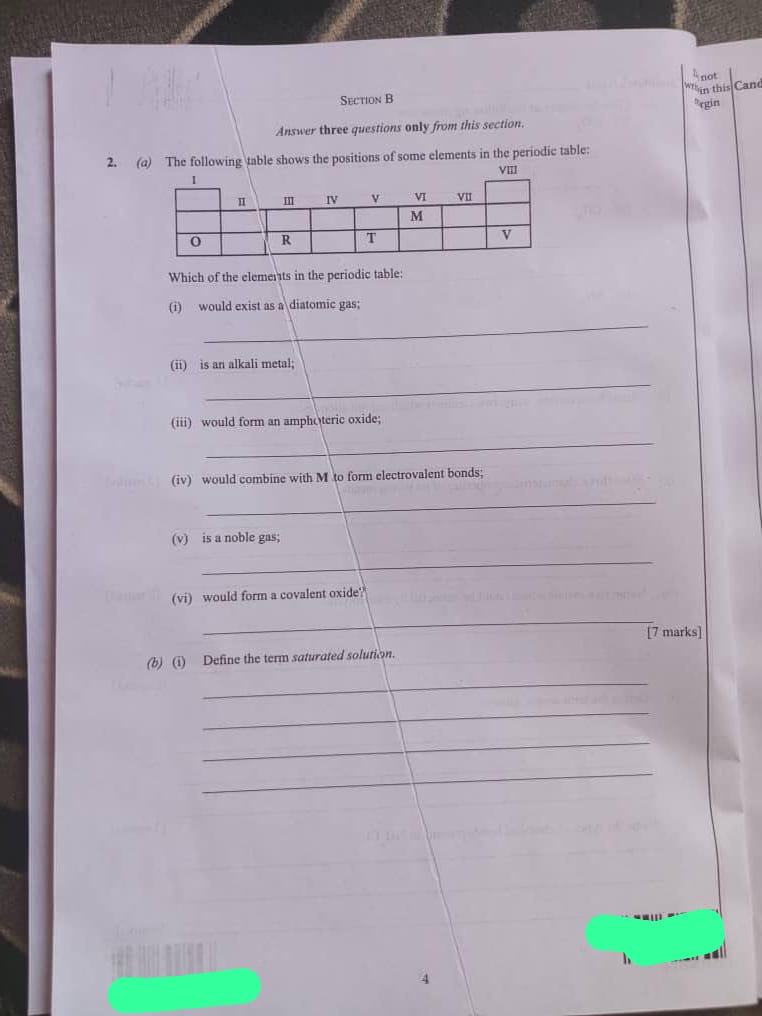
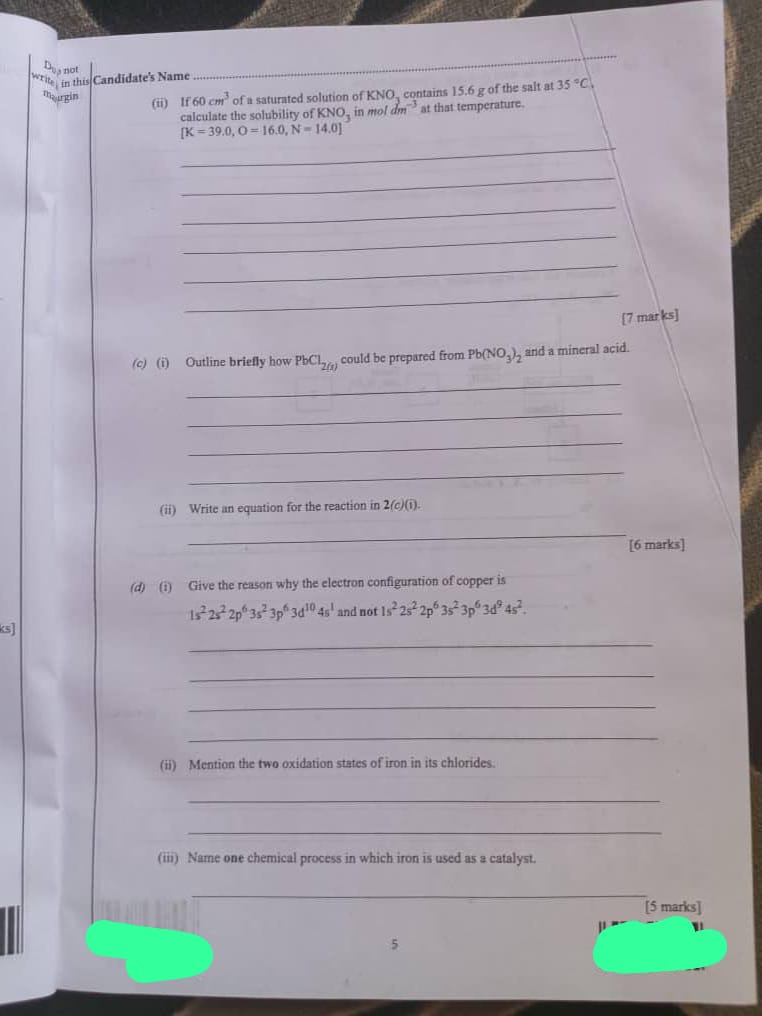
NUMBER 2
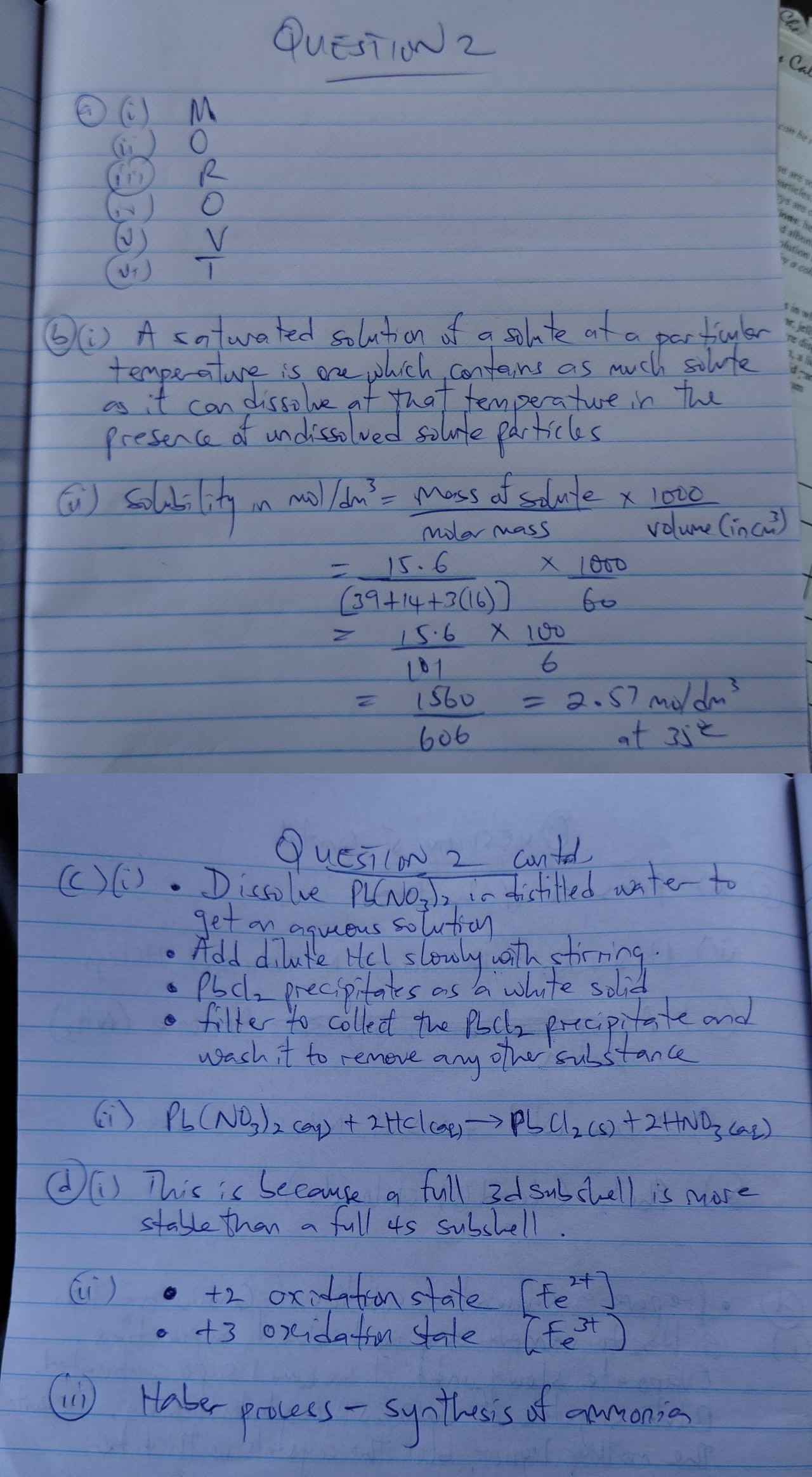
NUMBER 3
(3ai)
(PICK ANY ONE)
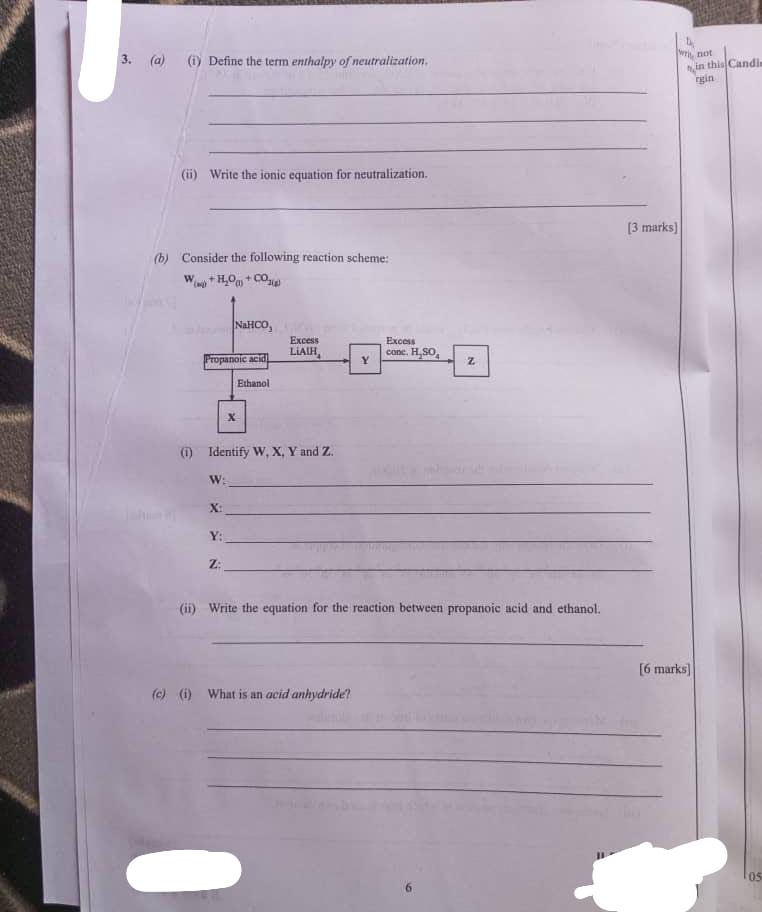
Enthalpy of neutralization is the heat change that occurs when one mole of water is formed by the reaction between an acid and a base in dilute aqueous solution.
OR
Enthalpy of neutralization is the enthalpy change when one mole of H⁺ ions reacts completely with one mole of OH⁻ ions to form one mole of water.
(3aii)
H⁺(aq) + OH⁻(aq) –> H₂O(l)
(3bi)
W = Sodium propanoate (C₂H₅COONa)
X = Ethyl propanoate (C₂H₅COOC₂H₅)
Y = Propan-1-ol (CH₃CH₂CH₂OH)
Z = Propene (CH₃CH=CH₂)
(3aii)
CH₃CH₂COOH + CH₃CH₂OH ⇌ CH₃CH₂COOCH₂CH₃ + H₂O
(3ci)
(PICK ANY ONE)
An acid anhydride is an oxide of a non-metal that reacts with water to form an acid.
OR
An acid anhydride is a compound which on addition of water produces the corresponding acid.
(3cii)
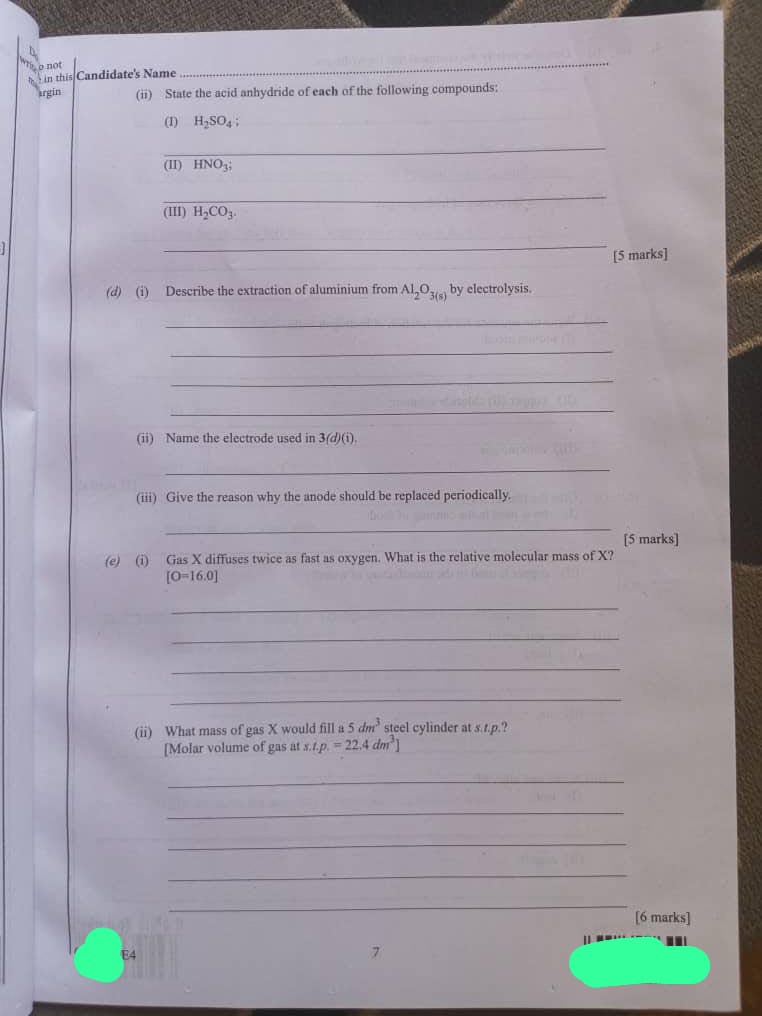
(I) H₂SO₄ — SO₃
(II) HNO₃ — N₂O₅
(III) H₂CO₃ — CO₂
(3di)
(PICK ANY ONE)
Aluminium is extracted from purified alumina (Al₂O₃) by the Hall-Héroult process. Alumina is dissolved in molten cryolite to lower its melting point and increase electrical conductivity. The molten mixture is electrolysed using carbon electrodes. During electrolysis, aluminium ions gain electrons at the cathode to form molten aluminium, while oxide ions lose electrons at the anode to form oxygen. The molten aluminium collects at the bottom of the cell and is tapped off periodically.
OR
Purified aluminium oxide is dissolved in molten cryolite and electrolysed in a steel tank lined with carbon. On passing electric current, Al³⁺ ions are discharged at the cathode to produce aluminium metal, while O²⁻ ions are discharged at the anode to produce oxygen gas. The molten aluminium settles at the bottom and is removed regularly.
(3dii)
Graphite electrodes
(3diii)
The carbon anode reacts with the oxygen produced during electrolysis to form CO₂ (and some CO), causing the anode to be gradually consumed; therefore it must be replaced periodically.
(3ei)
By Graham’s law:
Rate of diffusion ∝ 1/√M
Given that gas X diffuses twice as fast as oxygen,
2 = √(32/Mₓ)
4 = 32/Mₓ
Mₓ = 32/4
Mₓ = 8
Relative molecular mass of X = 8
(3eii)
Volume of gas = 5 dm³
Molar volume at s.t.p. = 22.4 dm³ mol⁻¹
Number of moles = 5/22.4 = 0.223 mol
Mass = number of moles × molar mass
= 0.223 × 8
= 1.79 g
Mass of gas X = 1.79 g
≈ 1.8 g
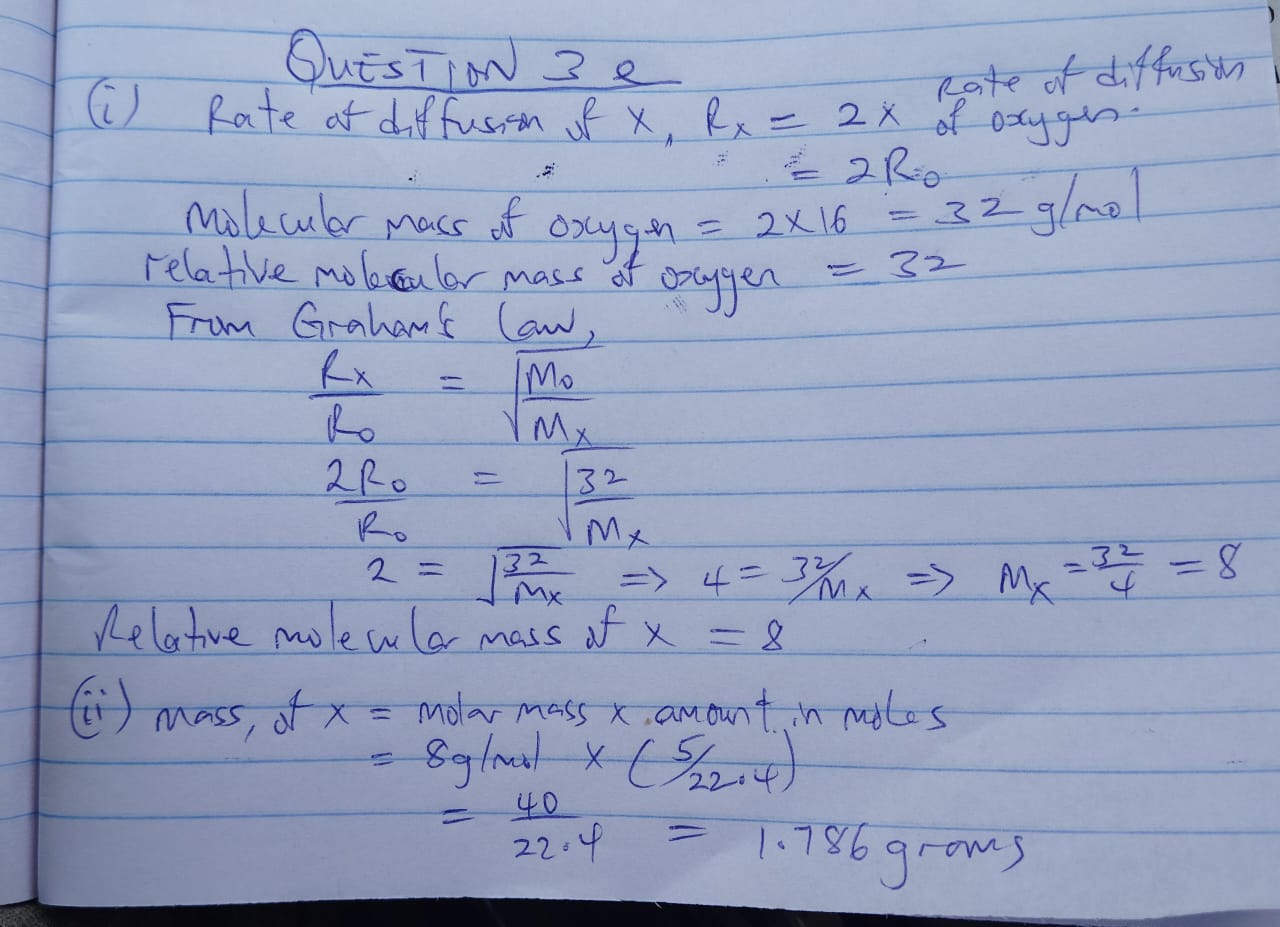
3e in paper format.
The typed format is correct.
Both are correct. This is for clearer view of the calculation
NUMBER 4
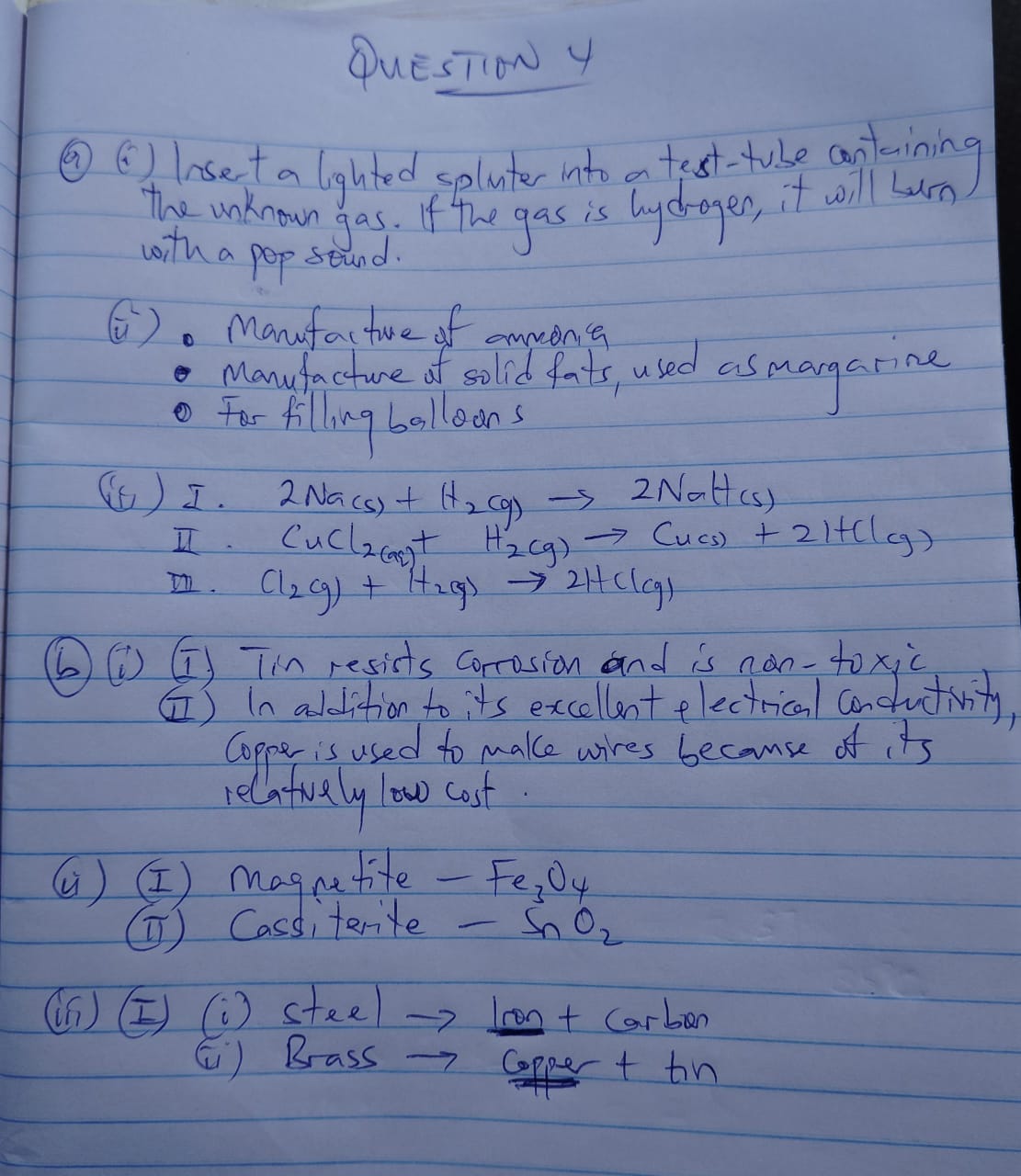
==================
(VERSION II)
(4ai)
(PICK ANY ONE)
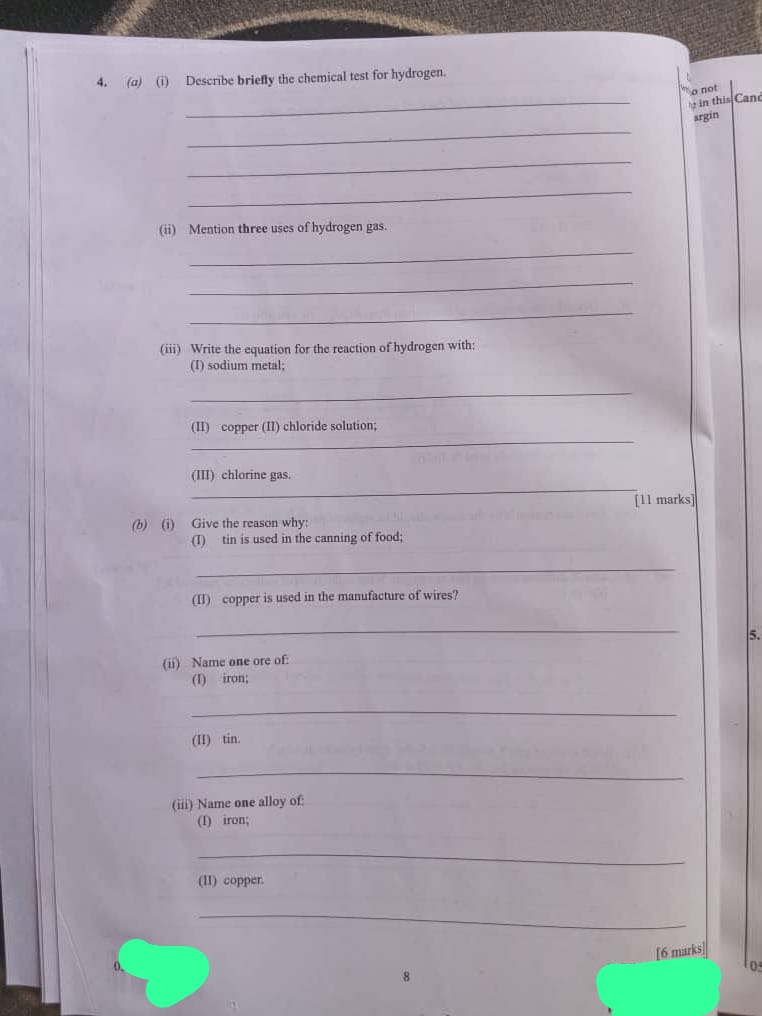
Hydrogen gas is tested by bringing a lighted splint to the mouth of the container holding the gas. The gas burns with a characteristic squeaky pop sound, confirming the presence of hydrogen.
OR
Bring a lighted splint to the mouth of a container containing the gas. If the gas is hydrogen, it burns with a ‘pop’ sound.
(4aii)
(PICK ANY THREE)
(i) It is used in the manufacture of ammonia by the Haber process.
(ii) Hydrogenation of vegetable oils to make margarine.
(iii) It is used as a fuel (e.g., rocket fuel/fuel cells).
(iv) Oxy-hydrogen flame for welding and cutting metals.
(v) It is used in the preparation of hydrochloric acid.
(4aiii)
(I) Sodium metal:
2Na+H₂ –> NaH
(II) Copper(II) chloride solution:
CuCl₂+H₂ –> Cu+2HCl
(III) Chlorine gas:
H₂+Cl₂ –> 2HCl
(4bi)
(I)Tin:
(PICK ANY ONE)
(i) It is resistant to corrosion
(ii) It does not readily react with food.
(iii) It is non-toxic (harmless) to food.
(iv) It forms a protective oxide layer that prevents rusting/corrosion.
(II) Copper:
(PICK ANY ONE)
(i) It is a good conductor of electricity.
(ii) It is ductile (can be drawn into wires).
(iii) It has low electrical resistance.
(iv)It is resistant to corrosion.
(4bii)
(I) Iron:
(PICK ANY ONE)
(i) Haematite (Fe₂O₃)
(ii) Magnetite (Fe₃O₄)
(II) Tin:
Cassiterite(SnO₂)
(4biii)
(I) Iron:
(PICK ANY ONE)
-Steel
-Cast iron
(II) Copper:
(PICK ANY ONE)
-Brass
-Bronze
(4ci)
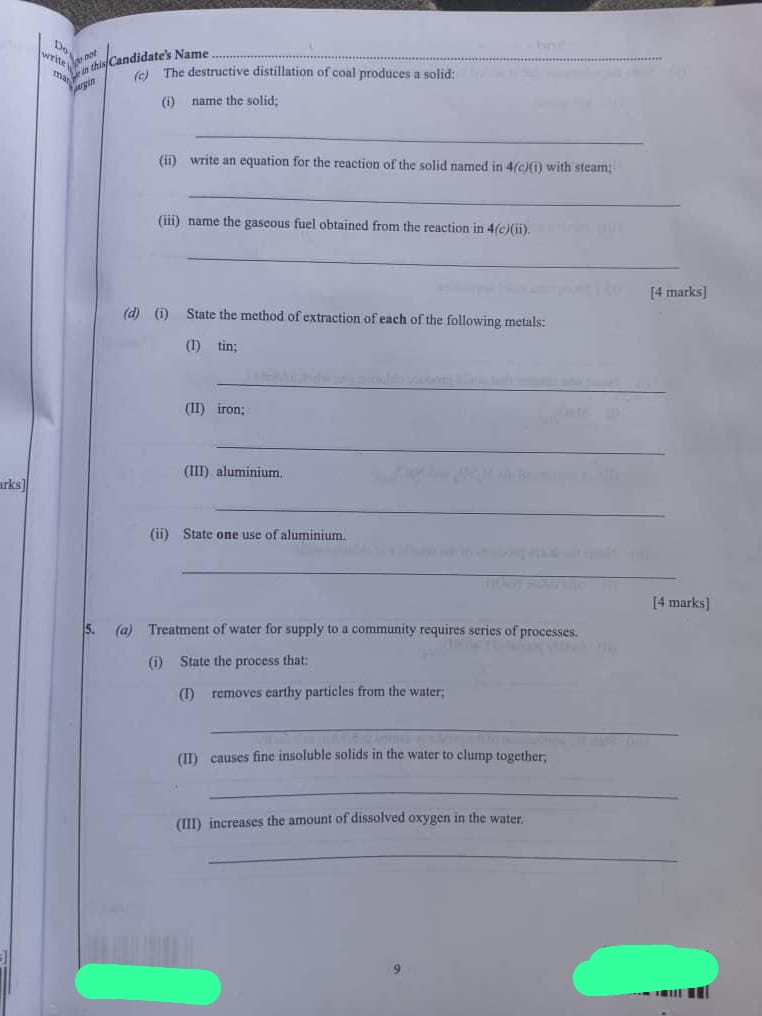
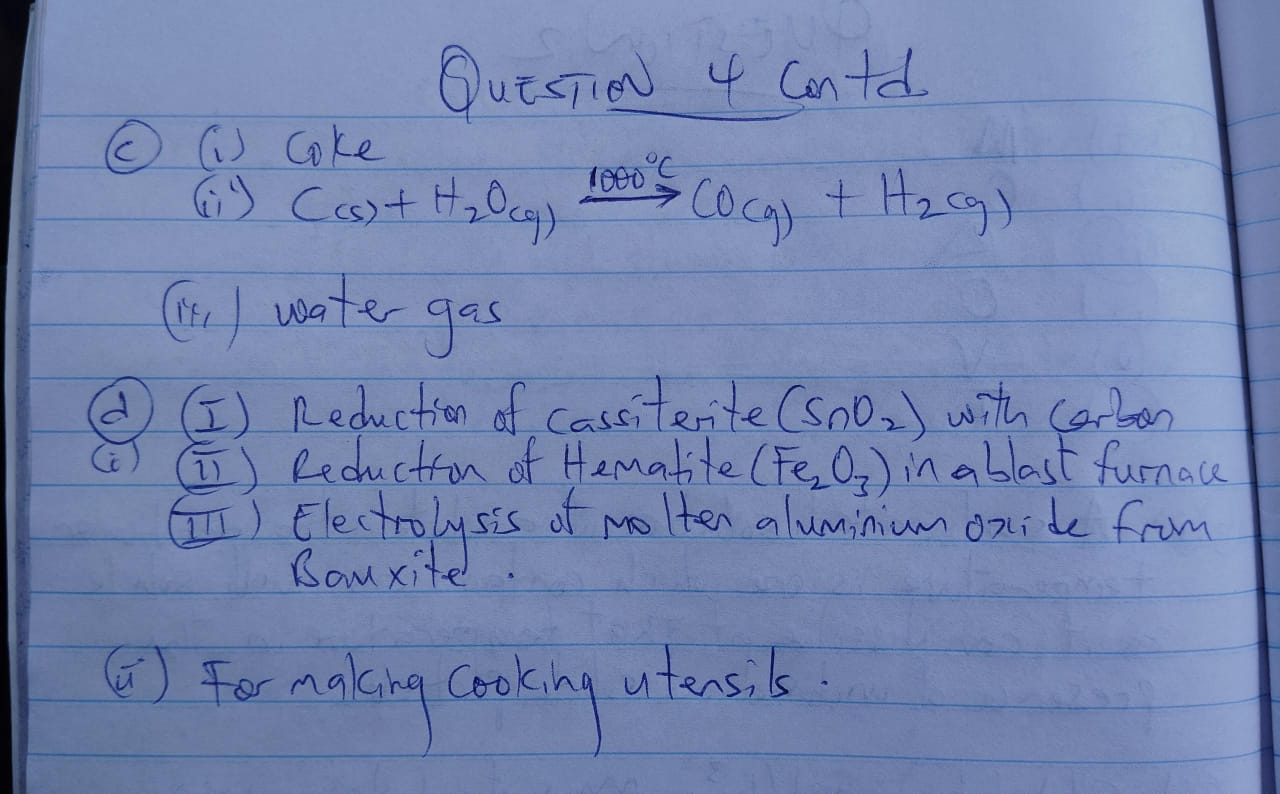
Coke
(4cii)
C+H₂O(g) –> CO+H₂
(4ciii)
Water gas
(4di)
(I) Tin:
Reduction of its oxide with carbon (smelting).
(II) Iron:
Reduction of its oxide with carbon monoxide in the blast furnace.
(III) Aluminium:
Electrolysis of purified alumina dissolved in molten cryolite.
(4dii)
(PICK ANY ONE)
(i) It is used in the manufacture of aircraft bodies.
(ii) It is used in the manufacture of cooking utensils .
(iii) It is used in the manufacture of overhead electrical cables.
(iv) It is used in the manufacture of roofing sheets.
NUMBER 5
======================
(VERSION II)
(5ai)
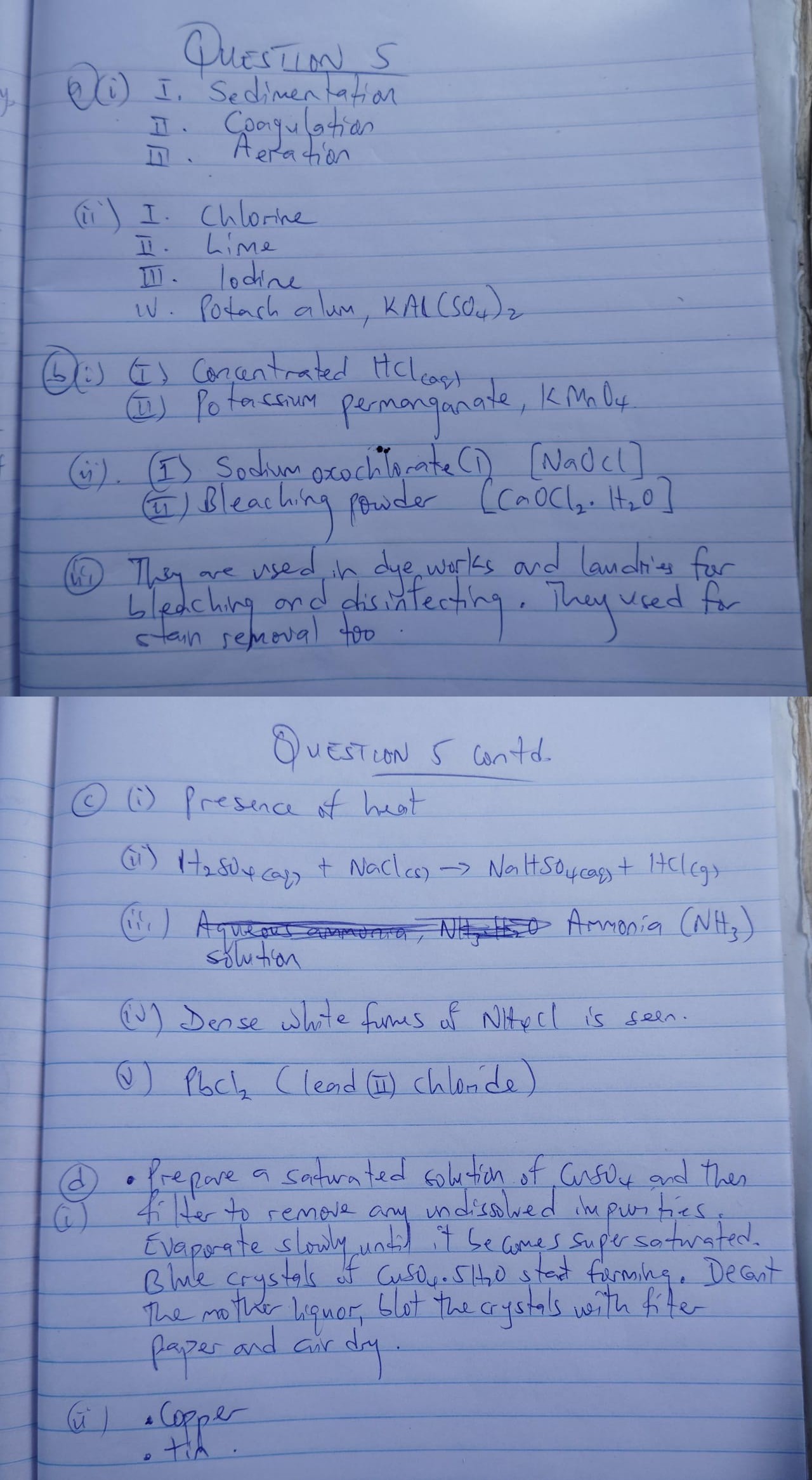
I: Removes earthy particles from the water
(PICK ANY ONE)
-Sedimentation
-Filtration
II: Causes fine insoluble solids in the water to clump together
(PICK ANY ONE)
-Coagulation
-Flocculation
III:Increases the amount of dissolved oxygen in the water
(PICK ANY ONE)
-Aeration
-Oxygenation
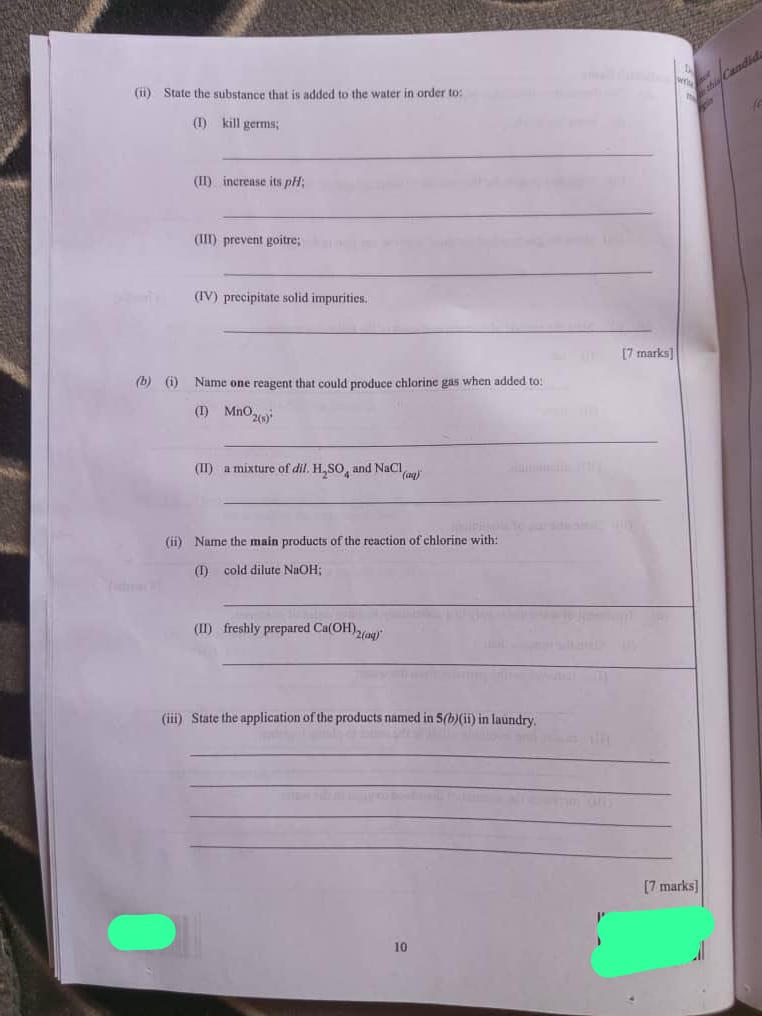
(5aii)
(I) Kill germs
(PICK ANY ONE)
-Chlorine
-Bleaching powder (calcium hypochlorite)
II:Increase its pH
(PICK ANY ONE)
-Slaked lime, Ca(OH)₂
-Soda ash (sodium carbonate)
III:Prevent goitre
(PICK ANY ONE)
-Potassium iodide
-Iodine compounds
IV: Precipitate solid impurities
(PICK ANY ONE)
-Alum (potassium aluminium sulphate)
-Aluminium sulphate
(5bi)
I: MnO₂(s)
(PICK ANY ONE)
(i) Concentrated hydrochloric acid (HCl)
(ii) Hydrogen chloride gas
II: A mixture of dilute H₂SO₄ and NaCl(aq)
(PICK ANY ONE)
(i) Manganese(IV) oxide (MnO₂)
(ii) Potassium permanganate (KMnO₄)
(iii) Potassium dichromate (K₂Cr₂O₇)
(5bii)
(I) Sodium chloride (NaCl)
(II)Calcium oxychloride (bleaching powder)
(5biii)
(i)Sodium chloride is used in the preparation of soap and other household cleaning agents.
(ii) Calcium oxychloride (bleaching powder) is used for bleaching and whitening clothes in laundry.
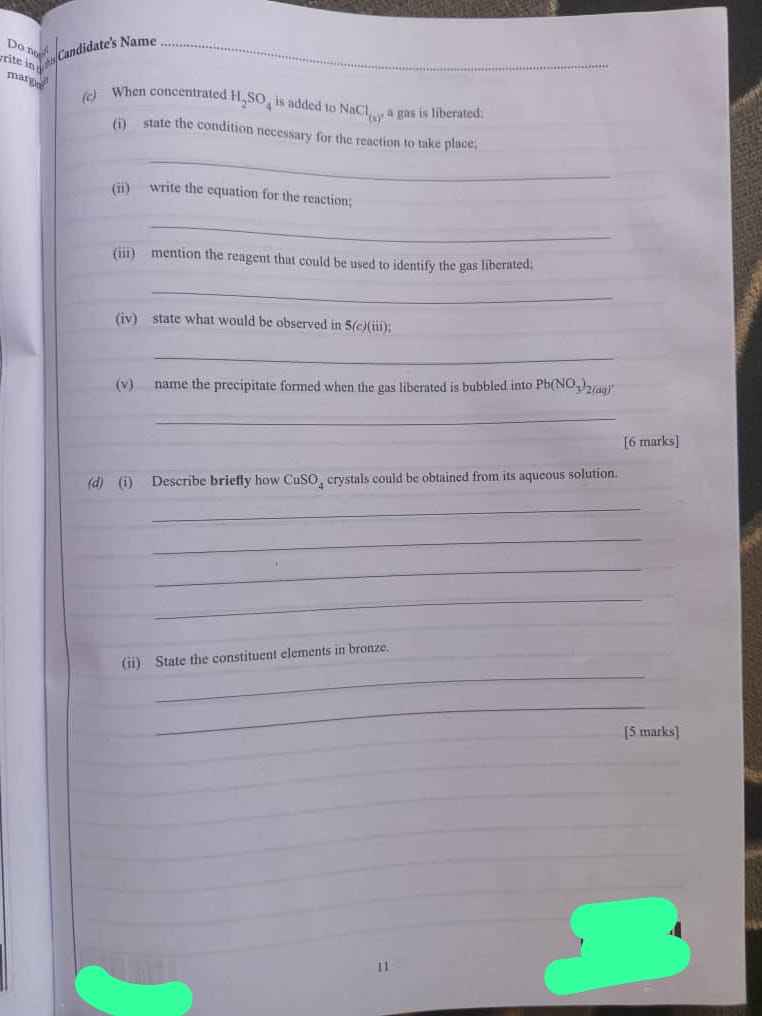
(5ci)
(PICK ANY ONE)
(i) The sodium chloride must be in the dry solid state.
(ii) The reaction should be carried out in the presence of heat.
(5cii)
NaCl(s) + H₂SO₄(l) → NaHSO₄(s) + HCl(g)
(5ciii)
Ammonia solution (NH₃(aq)
(5civ)
Dense white fumes of ammonium chloride are produced.
(5v)
Lead(II) chloride (PbCl₂).
OR
A white precipitate of lead(II) chloride.
(5di)
(i) Heat the copper(II) sulphate solution gently to evaporate some of the water until a hot saturated solution is obtained.
(ii) Allow the hot saturated solution to cool slowly and undisturbed so that crystals of copper(II) sulphate are formed.
(iii) Filter off the crystals and dry them between sheets of filter paper.
(5dii)
(i) Tin
(ii) Copper
OBJECTIVE ↘️
ESSAY↘️